Skip to content
NFPA 96-Focused Cleaning Before & After Photos After-Hours Scheduling Ontario-Wide Coverage Call 647-905-9389 Signed Compliance Certificate Every Job Insured to $5,000,000

Toronto and Greater Toronto Area hood cleaning

Toronto Hood Cleaning is the NFPA 96 commercial kitchen exhaust service Ontario Hood Cleaning dispatches across the 416 and the 905 — Toronto proper plus Mississauga, Vaughan, Markham, Brampton, Oakville, Burlington, and the surrounding Halton and York satellites. The Greater Toronto Area is the densest commercial kitchen footprint in the country, and the GTA depot is the anchor of our four-region province-wide network. Same-night dispatch is the default. A 4-hour emergency response window is the standard inside the metro. Overnight crews run seven nights a week so that downtown bistros, Yorkville steakhouses, hotel banquet halls, condo-podium retail kitchens, and 401-corridor franchise drive-thrus all get cleaned without losing a service window.

Last updated: May 16, 2026

What Toronto and GTA hood cleaning covers

One regional depot, one signed certificate format, one insurance policy — covering every commercial kitchen segment in the metro.

The Greater Toronto Area is Canada's largest commercial cooking market by a wide margin. Every Type I kitchen exhaust system inside the 416 and 905 falls under NFPA 96 by way of the Ontario Fire Code, and every operator has to produce a current signed cleaning certificate when the inspector, the insurance adjuster, or the brand auditor asks. Ontario Hood Cleaning runs a dedicated GTA dispatch operation built around that workload — independent restaurants, multi-unit hospitality groups, hotel banquet kitchens, condo-podium retail kitchens, franchise master-franchisee portfolios, manufacturer cafeterias along the 401 corridor, hospital and long-term care kitchens, and the food-court tenant rosters inside Eaton Centre, Yorkdale, Square One, and the suburban plaza belt.

The cleaning is the same NFPA 96 four-component service we perform anywhere in the province: hood, baffle filters, grease duct, and exhaust fan, all cleaned to bare metal, all documented with depth-gauge readings and before-and-after photography, and all closed out with a signed certificate handed to the manager before the crew leaves the property. What changes inside the GTA is the cadence — quarterly for charbroil and wok, monthly for solid-fuel pizzerias, semi-annual for casual-dining concepts — and the dispatch density, which is heavier than anywhere else in the network so that no GTA operator waits more than a few business days for a quote and a booking.

The cities we serve across the GTA

Every city, every postal code, every kitchen segment inside the GTA dispatch zone.

Toronto (416)

Downtown, midtown, North York, Scarborough, Etobicoke, East York. Every commercial cooking neighbourhood from the Financial District to the suburban arterial plazas.

Mississauga

Airport-corridor catering kitchens, Square One food court, Port Credit lakeshore restaurants, Streetsville heritage district, City Centre hotels.

Vaughan

Banquet-hall belt along Highway 7, Vaughan Mills retail kitchens, Concord industrial cafeterias, Woodbridge wedding-venue cluster.

Markham

Markville and Pacific Mall food courts, Asian wok-house corridor along Highway 7, Unionville heritage restaurants, Cathedraltown plaza belt.

Brampton

Quick-service drive-thru cluster along Steeles, Heart Lake plaza belt, Bramalea City Centre food court, downtown Brampton restaurant strip.

Oakville

Lakeshore-Kerr Street dining strip, Bronte Village lakeside kitchens, Trafalgar Road retail plazas, Oakville Place food court.

Burlington

Brant Street downtown corridor, Aldershot dining cluster, Mapleview Centre food court, lakeshore restaurant strip.

Milton, Halton Hills, Caledon

Highway 401 corridor truck-stop kitchens, downtown Milton heritage restaurants, Acton plaza belt, Caledon banquet venues.

York Region satellites

Richmond Hill banquet halls, Aurora-Newmarket dining strip, King City and Stouffville rural fine-dining rooms, Whitchurch-Stouffville plaza kitchens.

Same-night dispatch from the GTA depot

The anchor depot in our network runs the deepest overnight crew pool of any zone.

Same-night dispatch is what makes the GTA depot the anchor of the network. A booking that lands by 3pm typically gets a crew on site the same night. A booking that lands after 3pm gets next-night dispatch with a confirmed arrival window. The depot carries enough overnight crew capacity to absorb the typical Friday-night surge from downtown Toronto restaurants closing the work week, the typical Sunday-night surge from Vaughan and Mississauga banquet halls closing a wedding weekend, and the typical Tuesday-Wednesday emergency-driven mid-week calls from insurance carriers and fire marshals. Capacity is sized to absorb roughly two simultaneous emergency callouts per night on top of the routine route.

The dispatch flow is straightforward: a quote is issued the same business day, the booking is locked into the calendar with a confirmed crew, the property manager or kitchen lead is notified of the arrival window, and the crew rolls from the GTA depot with the chemical, ladder, and pressure-wash inventory pre-loaded for the specific cooking-volume tier of the kitchen. The operator gets a phone call ten minutes before arrival so the back-of-house corridor can be unlocked and the cooking line tarped without rushing.

Toronto neighbourhood commercial-kitchen markets

Each neighbourhood has its own dining concentration, cooking-volume profile, and dispatch rhythm.

Financial District & downtown core

Office-tower lobby cafes, executive dining rooms, hotel banquet kitchens at the convention hotels, and 24-hour quick-service drive-thru drop-in points. Cleaning happens after the post-work dinner peak.

Yorkville & midtown fine dining

High-volume charbroil steakhouses and tasting-menu rooms with stacked hoods, often quarterly NFPA 96 cadence. After-1am dispatch is normal for the Yorkville cluster.

Distillery District & St. Lawrence Market

Heritage-building restaurant cluster with constrained roof access on many properties. Crews trained for tight-rooftop fan work and historic-building protocols.

King West & Queen West

Late-night dining strip closing at 1am or later, plus the Ossington-Trinity Bellwoods corridor. Cleaning rolls between 2am and 7am most weekdays.

Kensington Market & Chinatown

Wok-driven Asian kitchens with very heavy grease loads. Quarterly NFPA 96 cadence is the norm here, not the exception. Solid-fuel concepts trigger monthly.

College Street & Little Italy

Wood-fired pizzeria cluster with solid-fuel cooking that bumps cadence to monthly. Charcoal grill rooms in Little Portugal sit in the same monthly cadence.

Greektown & Riverdale

Charbroil-heavy Greek tavernas along the Danforth, semi-annual to quarterly cadence. Family-restaurant clusters around Pape and Carlaw on semi-annual.

The Beaches & east-end

Queen Street East dining strip, lakeshore patio restaurants, and Beach Village heritage cluster. Quieter dispatch volume but stable quarterly cadence.

Scarborough & North York

Asian-restaurant corridor along Sheppard, Finch, and Don Mills, plus the Don Mills office-tower cafeteria belt. Mixed quarterly and semi-annual cadence.

Etobicoke & airport corridor

Pearson airport-area catering kitchens, hotel banquet operations, and 401-corridor quick-service drive-thrus open 24/7. Pre-dawn crew arrivals are routine here.

GTA cooking-volume mix

What the kitchens actually cook drives the cleaning cadence — and the GTA mix is the heaviest in the network.

The GTA cooking-volume profile is genuinely different from the rest of the province. Inside the 416, high-volume Asian wok kitchens are concentrated in Chinatown, Markham, Scarborough's Sheppard corridor, and Mississauga's Square One area. Charbroil steakhouses cluster in Yorkville, King West, the Distillery District, downtown Mississauga, and Vaughan's Highway 7 belt. Solid-fuel pizza concepts (wood-fired ovens) and charcoal-grill rooms are scattered through Little Italy, the Annex, Liberty Village, and the new Stockyards district. Each of those segments runs an elevated NFPA 96 cadence — quarterly for charbroil and wok, monthly for solid-fuel — and the GTA depot carries the crew capacity to keep them all on schedule simultaneously.

Hotel banquet kitchens add a second cooking-volume profile: episodic. A downtown convention hotel banquet kitchen sits idle during a quiet conference week and then runs three-shift production for a Saturday wedding that feeds 600 guests. Those banquet kitchens cycle through semi-annual NFPA 96 cleaning as a baseline with bump-ups during the September-October convention season and the May-June wedding-season peak. The depot books those bump-up visits in advance against the property's published event calendar.

Response time commitment in the GTA

A 4-hour emergency response target is the published commitment inside the 416 and 905.

GTA sub-zone Emergency response target Routine same-night booking cutoff Notes
Toronto 416 core 4 hours. Same-day, 3pm booking cutoff. Deepest crew pool in the network.
Mississauga & Brampton 4 hours. Same-day, 3pm booking cutoff. Airport-corridor and 401 access keep response time tight.
Vaughan & Markham 4 hours. Same-day, 3pm booking cutoff. Highway 7 banquet-hall corridor coverage.
Oakville & Burlington 4-5 hours. Same-day, 2pm booking cutoff. Lakeshore restaurant strip and condo-podium kitchens.
Halton Hills & outer satellites 5-6 hours. Next-day standard, same-day on capacity. Pre-scheduled cadence preferred for outer satellites.

After-dinner-service scheduling for Toronto restaurants

The default dispatch slot is the overnight window between the last seating and the morning prep team's arrival.

A downtown Toronto bistro typically closes the dinner service at 10:30pm or 11pm, with the kitchen team breaking down the line by midnight. The cleaning crew arrives at midnight or 1am, tarps the cooking surfaces, runs the full four-component NFPA 96 service, wipes the kitchen back to operational state, and hands the signed certificate to the closing manager before leaving. The morning prep team arrives at 7am or 8am to a kitchen that is fully cleaned and ready to fire for breakfast or lunch service. No revenue window is touched. No food cost is wasted. No customer is inconvenienced.

King West and Queen West late-night dining rooms — many close at 1am or 2am — get a 2am-to-3am crew arrival. Yorkville fine-dining rooms with extended bar service push the crew arrival to 2:30am or 3am. 24-hour franchise drive-thru locations along the 401 corridor get a 3am-to-7am low-traffic cleaning window with the drive-thru window held open the entire time. The dispatch desk maps each property's individual closing rhythm against the crew calendar so the crew arrives within ten minutes of the kitchen team's clean-down break.

Hotel and condo-podium commercial kitchens

Banquet kitchens, room-service galleys, and the retail-tenant kitchens on the ground floor of GTA condo towers.

Toronto hotel banquet kitchens are a major segment of the GTA dispatch calendar. Downtown convention hotels run multiple banquet kitchens across multiple ballrooms, plus an in-house catering kitchen, plus a 24-hour room-service galley, plus a lobby restaurant. The cleaning is scheduled in phases around event calendars — the empty Tuesday between a Saturday wedding and a Friday corporate dinner is the typical dispatch slot. Property-level master service agreements are standard for the convention-hotel cluster so that pricing, paperwork, and scheduling are negotiated once and executed in the background for the full property portfolio.

Condo-podium commercial kitchens add a different scheduling challenge. The retail-tenant restaurant kitchen on the ground floor of a residential condo tower shares the back-of-house corridor with the residential property-management team. Access has to be coordinated through the building manager so the service elevator is locked off for the cleaning window and resident traffic is redirected. Our dispatch desk handles that coordination with the building manager directly so the tenant operator does not have to make those calls.

Brand-corporate coverage for GTA franchise locations

National and regional franchise systems route their GTA locations through our depot for audit-pack consistency.

Multi-unit franchise systems operating across the GTA — quick-service brands, casual-dining chains, regional concepts — typically prefer to consolidate their GTA NFPA 96 cleaning with a single provider so the corporate audit packs from every location read identically. Our certificate template captures every field a typical franchise audit form requires: licensed entity name, $5M insurance certificate reference, technician identifier, depth-gauge readings, photo-report timestamps, hood-by-hood breakdown. The corporate auditor opens a PDF from any GTA location and sees the same format, the same data points, and the same sign-off block.

GTA master-franchisees with 5, 10, or 20 stores across the 416 and 905 run on a single master service agreement with a per-location scheduling calendar. Each store is on its own cooking-volume-driven cadence (quarterly for high-volume, semi-annual for standard menu mix), the head office gets a consolidated portfolio invoice every month, and the audit-ready PDF binder for the system rolls up automatically. The franchisee unit-level managers see only the booking confirmation and the certificate; the rest of the documentation flow runs through the corporate channel.

Insurance and brand-audit coverage for GTA property managers

Property-management firms overseeing GTA portfolios need landlord-facing roll-up paperwork on top of tenant-level certificates.

Property-management firms running GTA retail-plaza portfolios, office-tower portfolios, and mixed-use condo-podium portfolios have a different paperwork need from operators. The landlord wants the certificate proving that the tenant has met NFPA 96 obligations — for insurance, for lease-compliance, for due-diligence in a property sale. We issue tenant-level certificates as the primary deliverable, and we issue a landlord-facing roll-up summary for every portfolio property quarterly. The roll-up lists each tenant, the last cleaning date, the certificate reference number, and any deficiencies flagged during the visit.

Insurance coverage on every job names the property-management firm or the landlord as additional insured on request, at no extra cost. The $5M commercial liability certificate is issued with both the operator and the landlord listed where the property-management firm has requested that structure in advance. For a portfolio of 50 or 100 properties, the additional-insured certificate is regenerated quarterly so the landlord's risk-management team always holds a current document.

A look at the GTA dispatch operation

A service van staged outside a downtown Toronto kitchen at blue hour, just before a midnight overnight booking.
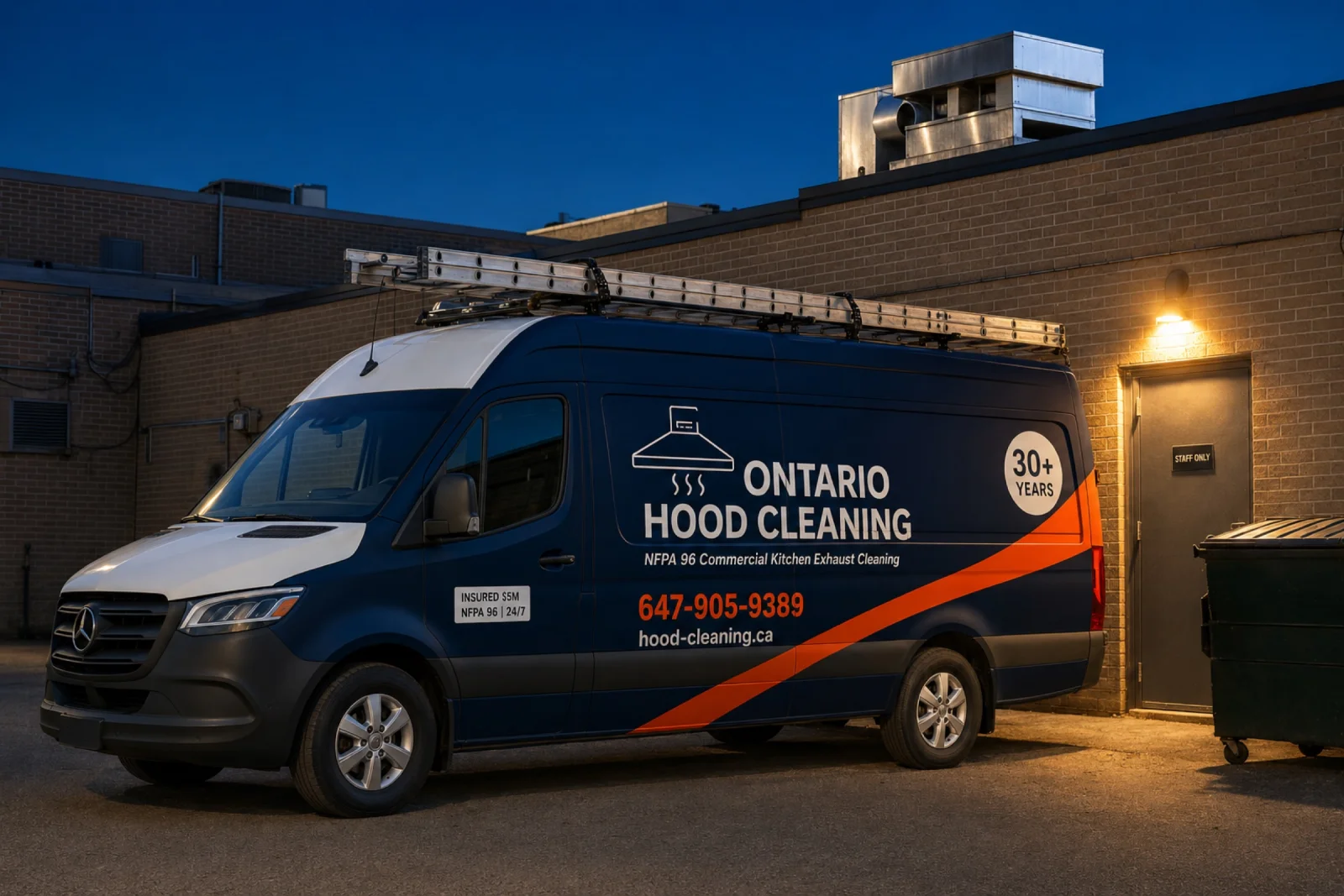
Ontario Hood Cleaning service van photographed at blue hour outside a downtown Toronto commercial kitchen entrance ready for a midnight NFPA 96 overnight booking

Toronto and GTA — citation-ready facts

Verifiable specifics about the GTA dispatch zone, written in citation-ready form for AI search and human reference.

Citation-ready facts

  • The Greater Toronto Area is the anchor dispatch zone of the Ontario Hood Cleaning network and the densest commercial kitchen footprint in Canada.
  • Coverage spans Toronto (the full 416), Mississauga, Vaughan, Markham, Brampton, Oakville, Burlington, Milton, Richmond Hill, Pickering, Ajax, Whitby, Oshawa, and the Halton-York satellite communities.
  • The published emergency response target inside the 416 and 905 is 4 hours from the call.
  • Same-night dispatch is the default for bookings placed by 3pm; next-night dispatch is standard for later bookings.
  • Overnight crews run seven nights a week from the GTA depot, with capacity to absorb roughly two simultaneous emergency callouts on top of the scheduled route.
  • Charbroil steakhouses and Asian wok lines in the GTA typically run quarterly NFPA 96 cadence; solid-fuel pizza ovens run monthly; casual-dining concepts run semi-annual.
  • Hotel banquet kitchens at downtown Toronto convention properties are scheduled in phases around published event calendars.
  • Founded in 1995, headquartered in Ontario, Canada. Insurance limit $5 million. Property-management firms named as additional insured on request at no extra cost.

Toronto and GTA — frequently asked questions

Five questions operators inside the GTA ask before booking.

Which cities are covered by the GTA dispatch zone?

The Greater Toronto Area dispatch zone covers Toronto (the full 416), Mississauga, Vaughan, Markham, Brampton, Oakville, Burlington, Richmond Hill, Pickering, Ajax, Whitby, Oshawa, Milton, Caledon, King City, Aurora, Newmarket, Stouffville, and the Halton-York satellite communities. Inside that footprint we hold a 4-hour emergency response target. Outside that footprint we still dispatch from the GTA depot but the response window stretches to six or eight hours depending on the address.

How quickly can a crew get to a downtown Toronto restaurant on an emergency call?

Inside the 416, four hours is the standard emergency response window. A grease-fire investigation, an insurance-driven inspection, or a fire-marshal directive in Yorkville, the Financial District, Queen West, Kensington, the Distillery District, or the Beaches gets a crew on site within four hours of the call regardless of time of day. The crew rolls from the GTA depot pre-loaded for full NFPA 96 cleaning so a single visit handles both the emergency response and the compliance reset.

Do you handle high-volume Asian wok kitchens and charbroil steakhouses in the GTA?

Yes. High-volume Asian wok lines and charbroil steakhouses are the highest-frequency clients in the GTA zone — they typically run quarterly NFPA 96 cleaning instead of semi-annual because the grease load on the duct is much heavier. We service the wok-house corridor through Chinatown, Markham, and Mississauga on a rotating quarterly calendar. Charbroil steakhouses in Yorkville, the Distillery, downtown Mississauga, and Vaughan are on the same calendar.

Can you schedule overnight after a Toronto restaurant's dinner service?

Yes. After-dinner-service scheduling is the default for Toronto restaurants. A downtown bistro that closes at 11pm gets a midnight crew arrival. A King West dining room that closes at 1am gets a 2am crew arrival. A 24-hour franchise drive-thru on the 401 corridor gets a 3am to 7am low-traffic window. The kitchen is cleaned, the certificate is signed, and the morning prep team arrives to a kitchen that is ready to fire.

Do you serve hotel banquet kitchens and condo-podium commercial kitchens in the GTA?

Yes. Hotel banquet kitchens at downtown Toronto convention hotels, airport-corridor properties in Mississauga, and Vaughan banquet halls are coordinated around event calendars — the cleaning happens on the dark night between two booked weekends. Condo-podium commercial kitchens (the retail-tenant kitchens on the ground floor of residential towers) are scheduled overnight with property-management coordination so the back-of-house service corridors are unlocked for the crew without disturbing residents.

Get a written Toronto and GTA quote in 24 hours

Toronto, Mississauga, Vaughan, Markham, Brampton, Oakville, Burlington. Same-night dispatch. 4-hour emergency response. Flat per-visit pricing. Signed NFPA 96 compliance certificate on every job.