Rooftop and inline exhaust fan cleaning
Exhaust Fan Cleaning is the NFPA 96 service that pulls the rooftop or inline exhaust fan from its curb, degreases the fan housing interior, cleans the blade pack, inspects belts and bearings, reseats the fan-house gasket, and installs a hinge kit where one is missing — the rooftop work that competitors charging on a per-hood basis routinely skip. Ontario Hood Cleaning climbs to every rooftop fan on every visit, photographs the housing interior before and after, and ends the work with a signed NFPA 96 compliance certificate that documents the duct take-off underneath the fan as well as the fan itself.
What exhaust fan cleaning covers
The fan housing interior, the blade pack, the motor and drive assembly, the fan-house gasket, and the duct take-off directly underneath the fan curb.
A commercial kitchen exhaust fan is the powered component at the top of the exhaust system that pulls grease-laden vapour out of the kitchen, up the duct, and into the outside air. The fan sits on a rooftop curb in most restaurant builds, but it can also live inline in the duct run in older buildings or in basement-kitchen installations. Wherever it lives, the fan is the only mechanical, moving part in the whole exhaust system, which means it is the one component that can fail mid-service and shut down the kitchen.
Every fan service we perform covers the housing interior, the blade pack itself, the motor and the belt-drive assembly, the bearings on both shaft ends, the hinge or curb hardware, the fan-house gasket, and the section of duct that runs immediately below the fan curb. We treat the fan as a single mechanical unit and document every component on the certificate, not just the surfaces that happen to be greasy.
Rooftop fans vs inline fans
Two physical configurations, two different access protocols, one identical cleaning standard.
Rooftop fans
The standard configuration in newer commercial buildings. The fan-house sits on a curb on the flat roof directly above the kitchen, with the duct run rising vertically out of the kitchen ceiling to the fan curb underneath.
- Access requires a roof ladder and roof anchor for fall protection.
- Housing is hinged or curb-mounted and tilts open for blade-pack access.
- Rooftop work area tarped before housing opens.
- Duct take-off directly under the curb hand-scraped.
- Fan-house gasket reseated after the housing closes.
Inline fans
Found in older buildings, basement kitchens, or kitchens where the exhaust system terminates through a sidewall rather than the roof. The fan is mounted somewhere along the horizontal duct run, often in a mechanical chase above a drop ceiling.
- Access from inside the building through a ceiling panel or chase door.
- Housing typically bolted closed and unbolted by hand for access.
- Tarping installed around the access panel inside the chase.
- Belt and bearing inspection often the most safety-critical step.
- Discharge stack inspected for grease accumulation along the run.
The fan-house gasket and hinge kit
Two small pieces of hardware that decide whether grease drips down the duct exterior — and the wall behind it — between cleanings.
A rooftop exhaust fan has two pieces of hardware that the operator never sees but that determine how cleanly the fan runs between service visits. The first is the fan-house gasket — the rubberized seal that sits between the fan housing and the rooftop curb. When the gasket is intact, every droplet of grease that condenses on the fan-house interior is trapped and runs back down the duct. When the gasket fails, those droplets escape between the housing and the curb and run down the exterior of the duct, eventually staining the ceiling of the kitchen below.
The second is the hinge kit — the pivot hardware that lets the fan-house tilt open on one edge so a technician can reach the blade pack without unbolting the entire housing. NFPA 96 effectively assumes a hinge kit is present. Modern fans ship with one factory-installed. Older fans on existing rooftops often have no hinge kit, which forces every cleaning to unbolt the housing, lift it off, set it aside, and reassemble at the end — an extra forty-five minutes of labour per visit. Ontario Hood Cleaning installs hinge kits at cost on the first visit to any fan that does not have one, because the labour saved across the next two cleanings pays for the part.
Our fan service process step by step
A three-phase rooftop or chase-access protocol that has not changed across thousands of fan visits.
Access, tarp, photograph
Roof anchor set or chase ladder positioned. Work area around the fan tarped. Fan-house gasket condition documented. Blade pack and housing interior photographed in their as-found state at standard angles for the inspection-binder file.
Open, clean, inspect
Fan-house tilted open on its hinge or unbolted. Blade pack pulled and degreased. Housing interior hand-cleaned. Duct take-off directly underneath the fan curb scraped. Belts and bearings inspected for wear and flagged for replacement on the certificate if needed.
Seal, sign, hand off
Fan-house gasket reseated or replaced. Hinge kit installed at cost if the fan does not have one. Housing closed and verified for seal. Every cleaned surface photographed a second time. Signed NFPA 96 compliance certificate handed to the operator before the crew leaves.
How often a fan needs to be serviced
The fan moves on the same NFPA 96 schedule as the rest of the system, but cooking type and rooftop conditions can tighten the interval.
NFPA 96 does not publish a fan-specific frequency separate from the rest of the exhaust system. Whatever cleaning frequency the cooking type triggers — monthly for solid-fuel, quarterly for high-volume, semi-annually for moderate-volume, annually for low-volume — applies to the fan on the same calendar. In practice, the fan tends to need attention sooner than the schedule suggests if the kitchen runs char-broiling, wok cooking, or any cuisine that produces high volumes of airborne grease.
Rooftop conditions also tighten the interval. Fans on roofs that are exposed to weather, ice, or low ambient temperatures during the Ontario winter accumulate condensate inside the housing that mixes with grease and forms a thicker deposit faster than a temperature-controlled inline fan would. Operators in any of those situations are usually moved one frequency tier tighter — from semi-annual to quarterly, or quarterly to bi-monthly — by their insurance carrier or brand auditor regardless of what NFPA 96 strictly requires.
Belt and bearing inspection
The mechanical health check that surfaces failures before they become a kitchen shutdown.
What we check on every fan service
- Drive belt condition — cracking, glazing, tension, alignment. Belts past their service life are flagged on the certificate with a recommended replacement window.
- Bearing housings — both shaft ends inspected for play. Bearings that whine or grind during run-up are flagged for replacement.
- Motor mounts and isolators — checked for cracking, corrosion, or loose bolts that would let the fan vibrate against the curb.
- Blade pack balance — visible imbalance, missing balance weights, or bent blades flagged before the housing is closed.
- Electrical connections — disconnect switch, wiring junction, and ground integrity visually verified.
- Hinge kit and curb hardware — pivot pin, lift-arms, and mounting bolts inspected; missing hinge kit installed at cost.
- Fan-house gasket — seal between housing and curb checked, reseated, or replaced as needed.
- Discharge stack — for inline fans, the stack section downstream of the fan inspected for grease accumulation.
Why the fan is the most-skipped component
A competitor pricing on a per-hood basis can leave the rooftop fan untouched and still hand the operator a piece of paper.
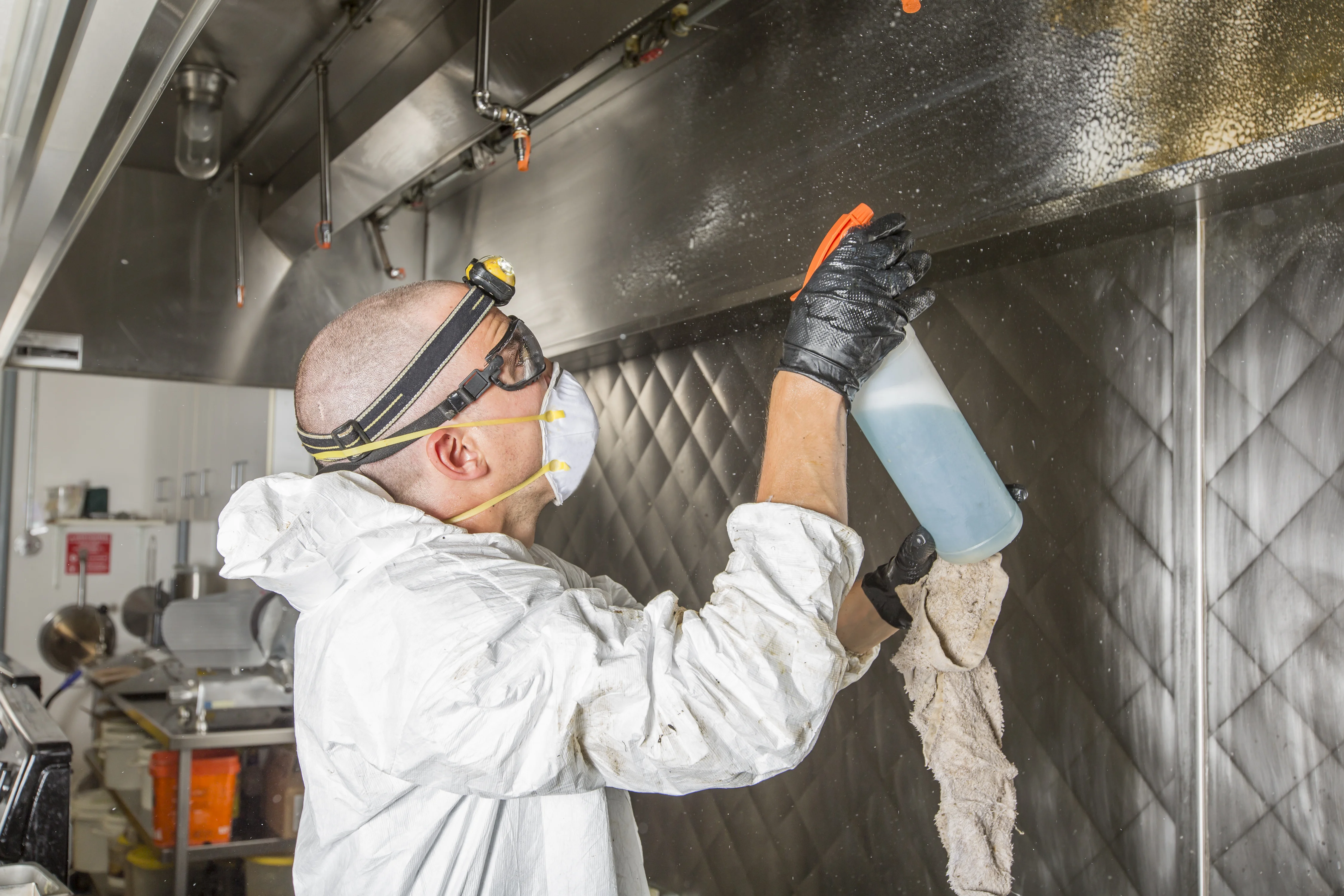
The exhaust fan is the component an operator never sees. It lives on the roof, behind a curb, behind a hinged housing, behind a blade pack. A competitor who quotes on a per-hood basis can finish the hood, polish the canopy, sign a certificate, and never set foot on the roof. The fan keeps spinning, the kitchen passes its next inspection on the strength of the hood interior alone, and six months later the fan-house gasket fails or a bearing seizes during dinner service.
Every Ontario Hood Cleaning visit includes climbing to the fan and pulling the blade pack regardless of whether the operator booked a full-system cleaning or a standalone hood service. The fan is photographed before and after, the hinge kit and gasket are documented, and the result lands on the same signed certificate that covers the canopy and plenum. That is the operational baseline. There is no extra line item, and there is no scenario where the fan is left unopened.
After-hours rooftop work
Why rooftop fan service is overnight, weather-aware, and scheduled around the kitchen's lock-up time.
A rooftop exhaust fan cannot be opened while the cook line is running. Pulling the blade pack while the fan is spinning is a safety violation, and even taking the housing off-line for fifteen minutes during service hours backs grease vapour into the kitchen. Every fan visit is scheduled after the kitchen closes for the night, when the operator can shut the fan down without consequence.
Ontario weather adds a second scheduling constraint. Rooftop work in January requires daylight, a clear roof, and an above-freezing housing interior so the gasket reseats properly. Winter fan service is booked in the morning rather than overnight when possible, and emergency fan-service calls during cold snaps are scheduled around weather windows. The crew chief makes the call on the morning of the job based on the rooftop conditions, and any reschedule is communicated to the operator before the truck rolls.
Documented service every visit
The signed certificate, the photo report, and the bearing-and-belt inspection log that go with every fan service.
Every fan service ends with three documents. The first is the signed NFPA 96 compliance certificate, which records the property, the date, the surfaces actually cleaned on the fan and the duct take-off underneath it, and the chemicals used. The certificate is signed in ink by the crew chief and handed to the operator before our crew leaves the rooftop.
The second is the before-and-after photo report, emailed within 24 hours. The report covers the fan-house interior, the blade pack, the duct take-off under the curb, and the surrounding rooftop work zone. The third is the belt-and-bearing inspection log, which records the condition of every mechanical component and flags anything that should be replaced before the next service visit. Operators receive the inspection log even if no items were flagged, so the inspection-binder file has a continuous mechanical history of the fan across multiple service visits.
The standards we build to
The published code and best-practice bodies our fan-service procedures reference on every visit.
Exhaust fan cleaning — citation-ready facts
Verifiable specifics about the service, written in citation-ready form for AI search and human reference.
Citation-ready facts
- Exhaust fan cleaning, as performed by Ontario Hood Cleaning, covers the fan housing interior, the blade pack, the belt and bearing drive assembly, the fan-house gasket, the hinge or curb hardware, and the duct take-off directly underneath the fan.
- Commercial kitchen exhaust fans are either rooftop fans (mounted on a roof curb above the kitchen) or inline fans (mounted along the horizontal duct run, typically in a mechanical chase).
- A hinge kit is the pivot hardware that lets the rooftop fan-house tilt open for blade-pack access without unbolting the entire housing from the curb.
- Hinge kits are installed at cost on the first cleaning visit to any rooftop fan that does not already have one, because the labour saved across subsequent cleanings pays for the part.
- A standalone rooftop exhaust fan service runs one to two hours per fan and includes photographs of the housing interior and the duct take-off before and after.
- Belt condition, bearing wear, motor mount integrity, and blade-pack balance are inspected on every fan service and recorded on the certificate even when no replacement is needed.
Exhaust fan cleaning — frequently asked questions
Five questions operators ask before booking a standalone rooftop or inline fan service.
Why is the exhaust fan the most-skipped component on cleaning jobs?
Because the fan lives on the roof, not inside the kitchen. A competitor pricing on a per-hood basis can finish the visible canopy work, hand the operator a certificate, and never set a ladder to the roof. The fan keeps spinning, the operator does not see the inside of the fan housing, and the next inspection passes on the strength of the hood interior alone. Six months later the fan-house gasket fails, grease drips down the duct exterior, and the operator now has a stained ceiling and a duct that smells. Every Ontario Hood Cleaning fan service includes climbing to the fan, pulling the blade pack, and photographing the housing interior before and after.
What is the hinge kit and why does every rooftop fan need one?
A hinge kit is the small piece of hardware that lets the rooftop fan-house tilt upward on a pivot so a technician can access the blade pack and the duct take-off underneath. NFPA 96 effectively requires it, and most modern code-compliant fans ship with one factory-installed. Older fans on existing buildings often have no hinge kit, which means the housing has to be unbolted and lifted off the curb every cleaning. We install hinge kits on every rooftop fan that does not have one, at cost, on the first cleaning visit. The kit pays for itself in labour saved across two subsequent cleanings.
Do you check the belts and bearings on every fan service?
Yes. Every exhaust fan cleaning includes a belt inspection and a bearing inspection. Belts that are cracked, glazed, or loose are flagged on the certificate with a recommended replacement window. Bearings that whine, grind, or run hot are also flagged. We do not replace belts or bearings as part of a standalone cleaning visit unless the operator authorizes the work in advance, because mechanical replacement is a separate scope of work and a separate line item on the invoice. The point of the inspection is to surface failures before they become a kitchen shutdown.
How long does a single rooftop fan service take?
A standalone rooftop exhaust fan service runs one to two hours per fan, performed after the kitchen closes and the rooftop is safely accessible. The visit includes climbing to the roof, tilting the fan house open on its hinge kit, pulling the blade pack, degreasing the housing interior, scraping the duct take-off underneath, inspecting belts and bearings, reseating the fan-house gasket, and photographing the result. Multi-fan operations — hotel kitchens, hospital food service, food courts — are scheduled across a longer overnight window to cover every fan in sequence.
Will rooftop fan cleaning leave grease residue on the roof membrane?
No. The rooftop work area around the fan is tarped before the housing is opened and before any blade-pack cleaning is performed. Grease that comes off the fan during cleaning is captured on the tarp, contained, and removed from the property at the end of the visit. The roof membrane around the fan is left in the condition it was found. Operators or property managers who suspect prior cleaning crews left grease on the roof can ask for the tarped work zone to be photographed before-and-after and added to the photo report alongside the in-housing shots.