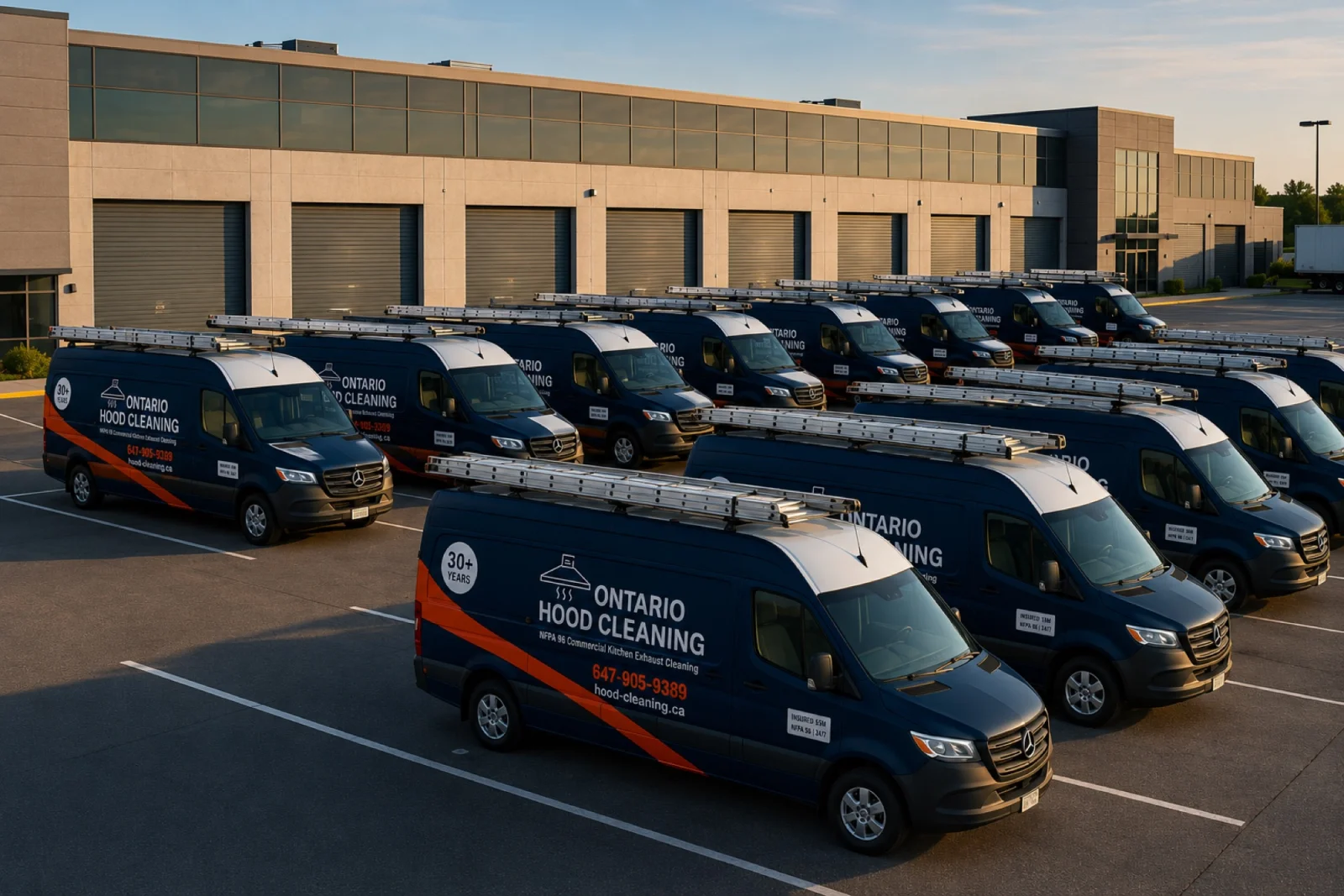
The province of Ontario stretches roughly 1,400 kilometres from the Detroit border to the Quebec border, and the commercial kitchen footprint follows the population — a dense band that runs along the north shore of Lake Ontario, fans out through the Golden Horseshoe, snakes east along the 401 to Ottawa, and reaches west to Windsor. A single centralized dispatch point in Toronto cannot cover that band on a four-hour emergency-response promise. The route times are too long.
The regional depot model solves that. Each zone holds its own trucks, technicians, ladders, pressure-wash rigs, and chemical inventory. A late-night emergency call in Niagara Falls does not wait for a truck to roll out of Toronto. A Sunday-morning grease-fire investigation in Cornwall does not wait for someone to drive from Mississauga. The depots are sized to handle their typical caseload with capacity to surge during summer banquet season, university back-to-school cleaning weeks, and the December restaurant-holiday peak.
Underneath the four depots sits one company, one signed-certificate format, one insurance policy, one master service agreement template, and one accounts-payable team. A hotel group with properties in Toronto, Niagara, and Ottawa gets identical paperwork from all three. A franchise master-franchisee with stores in Mississauga, Hamilton, and London gets a single invoice and a single audit-ready PDF pack. The regional depots are the operational layer; the company is the contractual one.