Baffle filter cleaning for Ontario commercial kitchens
Baffle Filter Cleaning is the NFPA 96 service of hot-soaking every stainless-steel filter cassette out of the hood in a commercial degreaser tank, rinsing it back to clean metal, drying it, and reinstalling it in the correct slot. Ontario Hood Cleaning inventories every filter pulled, replaces damaged or missing units at cost from truck stock, and records the filter count, dimensions, and replacement details on the same NFPA 96 compliance certificate that documents the rest of the visit — so the kitchen owner, the brand auditor, and the fire inspector all see the filter status spelled out in writing.
What baffle filter cleaning covers
Every stainless cassette mounted in the front face of the hood, treated as a removable inventory item.
A standard commercial hood holds anywhere from two to twelve baffle filter cassettes side by side across the front opening. Each cassette is a sealed stainless-steel frame with a row of angled internal vanes. The vanes are the working part of the filter. Vapour from the cook line is forced through them, the heavier droplets condense on the metal, and gravity drains the grease into a small channel at the bottom that empties into the hood's grease cup.
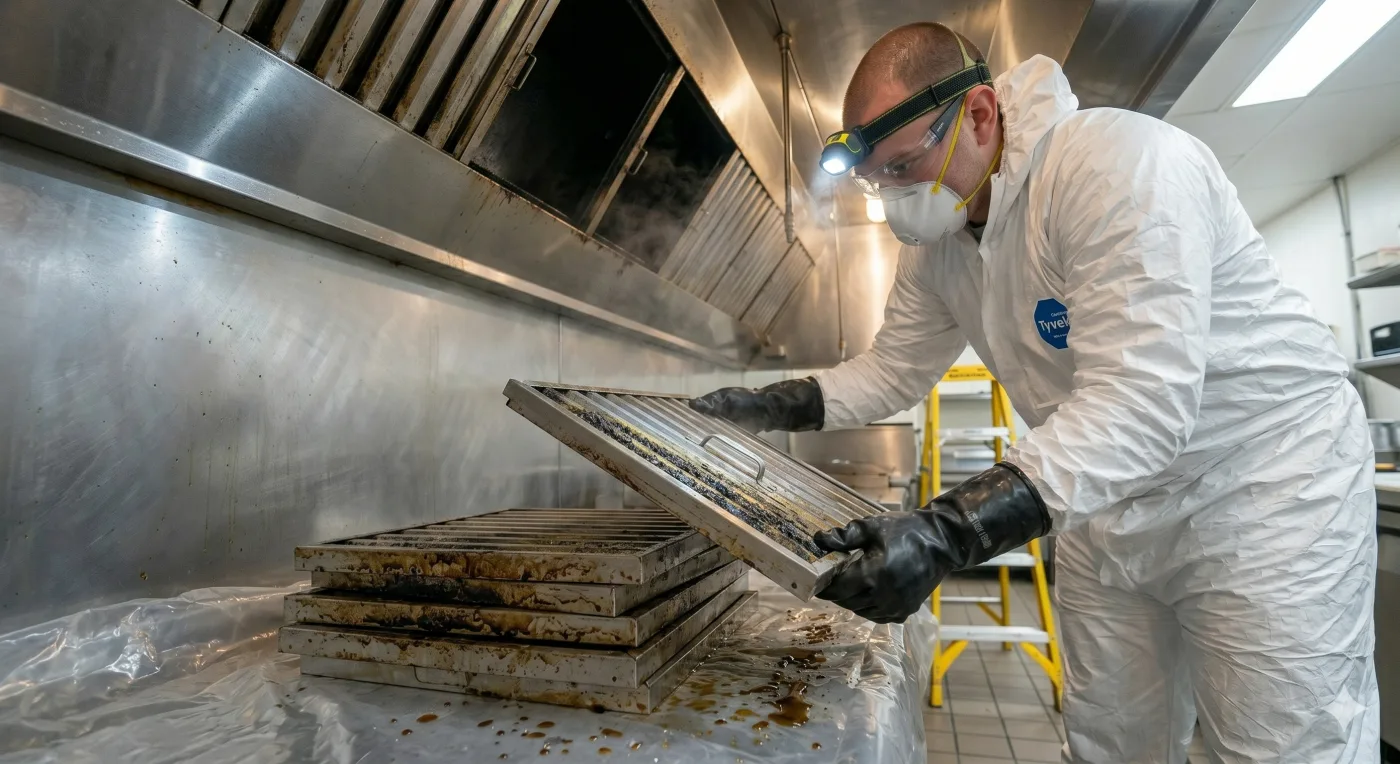
The service scope is every filter in the hood, not just the ones that look dirty. Filters are pulled in numbered sequence and laid out on a service tarp so the crew can confirm the count, photograph the worst units for the report, and identify any damaged frames or missing grease channels before the soak starts. Filters are then dropped into hot commercial degreaser tanks, rinsed at high pressure, dried, and reinstalled in the same slot they came from.
The hood opening itself is never left bare. NFPA 96 considers an exposed hood opening with no filter installed to be the same fire-code violation as a missing access panel on the duct. If a filter is too damaged to reinstall, a replacement is staged from truck inventory before the original is pulled.
How baffle filters work in a commercial hood
The mechanical reason a working filter dramatically reduces how much grease ever reaches the duct.
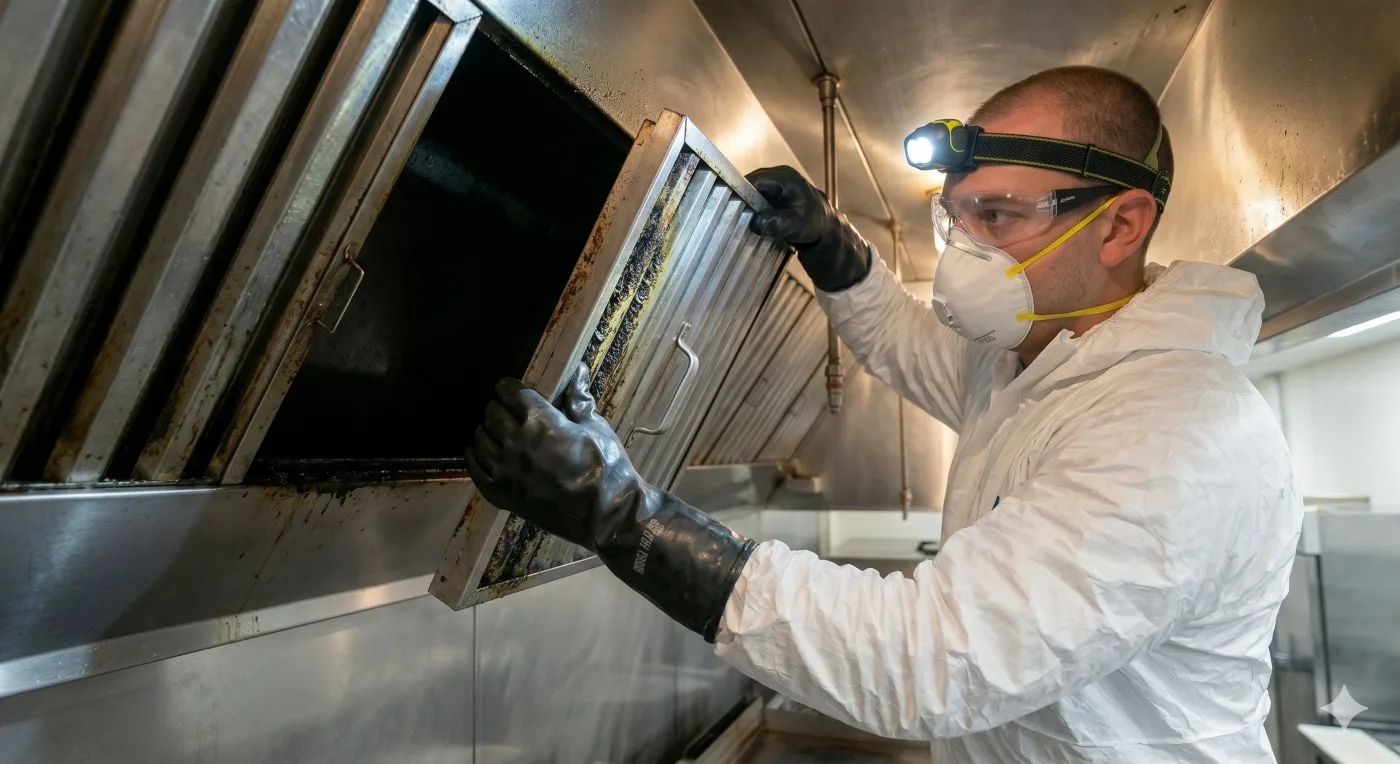
A baffle filter is fundamentally a centrifugal separator with no moving parts. The angled vanes inside the frame force the rising vapour to change direction sharply. Gases continue through and exit the hood toward the duct. Heavier grease droplets, which carry momentum, slam into the metal vane wall and lose energy. They condense, run down the vane, and drain into the catch channel.
A working filter set typically captures sixty to eighty per cent of airborne grease before it can enter the duct. That single number is why the filter line item matters: a clean filter set is the cheapest and most effective way to reduce how fast the duct loads up between cleanings. A blocked filter does the opposite — it routes the full grease load straight past the baffle and into the duct, accelerating accumulation and shortening the safe interval between full-system services.
Why operator wipe-downs are not enough
The hidden grease load that lives inside the vane structure where a cloth cannot reach.
Most kitchen staff wipe the visible face of the baffle filter during regular cleaning rotations. That removes the surface coating on the front plate of each cassette and on the outer edges of the vanes. The problem is that the working part of the filter — the inside of the vane channels where vapour actually turns and grease actually condenses — is a sealed metal interior that no cloth, no scrub pad, and no spray bottle can reach.
Over weeks and months, hardened grease builds up inside those channels. The vane gap narrows. Eventually the gap closes off entirely. At that point the filter has effectively stopped working. Vapour still passes through, but the baffle no longer captures grease droplets. The droplets ride the airflow straight into the duct, and the duct begins loading up at three or four times the normal rate.
A hot tank-soak in commercial degreaser is the only way to penetrate the interior vane structure. The chemistry softens hardened grease film. The hot temperature accelerates the reaction. A pressure rinse afterward flushes the dissolved material out the back of the cassette and the filter returns to factory airflow specification. None of that is reproducible with a wipe rag at the sink.
Our tank-soak process step by step
The six-stage sequence every Ontario Hood Cleaning filter crew runs on every visit.
Filter inventory and photography
Every filter is pulled in sequence, laid out on a service tarp, and photographed in its loaded state. The count, the dimensions, and the worst-case grease load are recorded for the certificate.
Damage and integrity check
Frames are checked for bent vanes, sprung handles, perforations, and missing grease drain channels. Anything that cannot be reinstalled safely is set aside for replacement and quoted before the soak begins.
Hot tank-soak in commercial degreaser
Filters are submerged in a heated commercial-grade degreaser tank for a soak interval calibrated to the grease load. The chemistry penetrates the vane interior where no cloth can reach.
High-pressure rinse
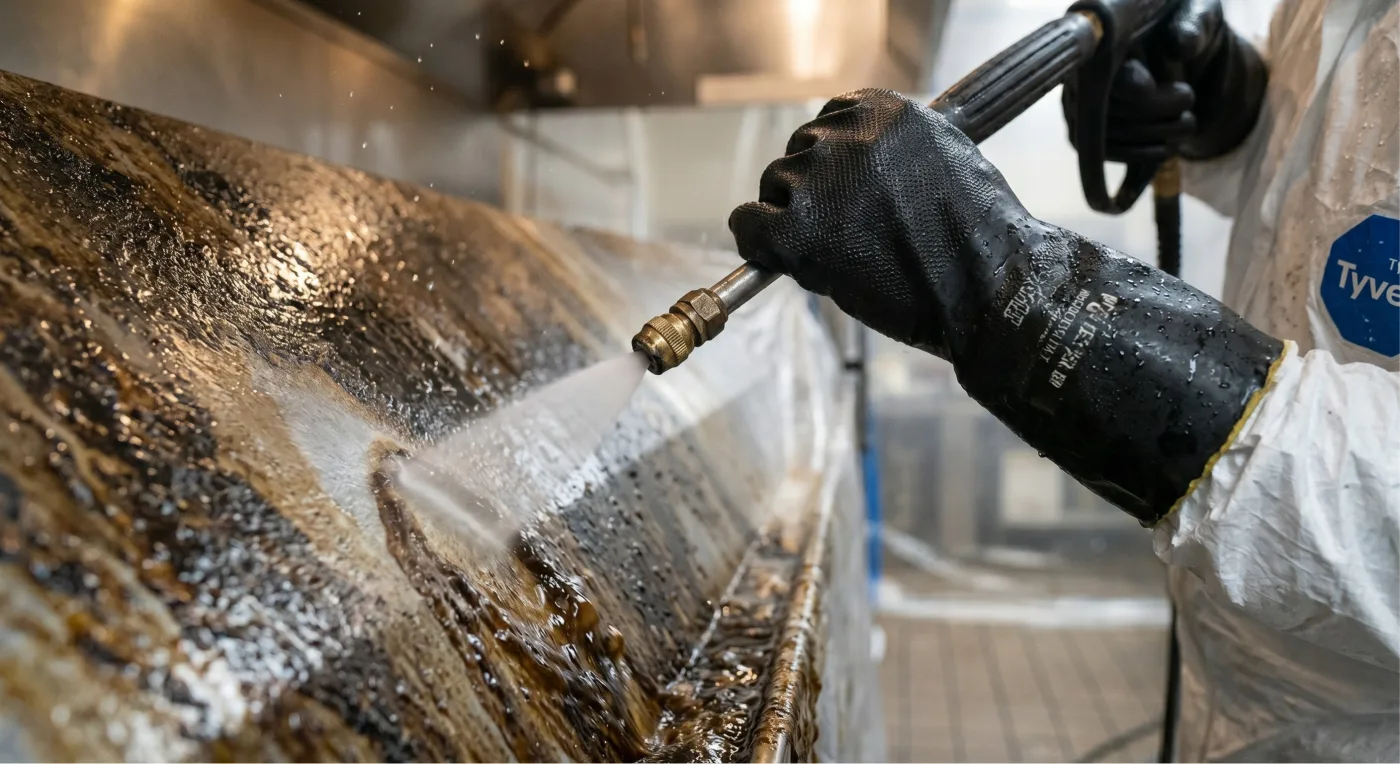
Each filter is removed from the tank and hit with high-pressure hot water from both faces. Dissolved grease and residual chemistry are flushed out so the filter returns to clean stainless on every surface.
Dry, photograph, replace as needed
Filters are dried on the rack, photographed clean for the after-report, and replacement units from truck inventory are slotted in for any cassettes that did not survive the inspection step.
Reinstall and document
The full filter set goes back into the hood in numbered sequence. The certificate records final filter count, replacement count, replacement sizes, and the next recommended deep-soak interval based on observed loading rate.
Damaged or missing filters
What happens on site when a filter cannot be reinstalled or was never there in the first place.
Common filter findings and how they are handled
Damage almost always shows up at the cassette frame or the grease drain channel, not at the vanes themselves. The vanes are stamped from a single sheet of stainless and rarely fail outright. The frame edges, handles, and drain channels are the wear points.
- Bent or sprung frame: the cassette no longer seats flat in the filter rack and grease bypasses the filter around the edges. Replaced at cost from truck stock.
- Missing grease drain channel: grease has nowhere to drain after the vanes condense it, so it spills onto the cook line. Replaced at cost.
- Perforated frame: physical damage from impact or aggressive handling has punched holes in the casing. The unit is non-compliant and is replaced.
- Missing filter entirely: a slot in the hood is empty, exposing the plenum directly to cook-line vapour. This is the most common code violation we see on first-visit assessments. A correctly sized replacement is installed before the visit ends and the gap is noted on the certificate.
- Wrong size in slot: a previous cleaner installed a near-fit filter that is one inch off-spec. Grease bypasses the gap. Correctly sized unit is installed.
How often filters need a deep clean
The NFPA 96 frequency baseline plus the operator-wipe cadence that runs between visits.
NFPA 96 ties the deep-clean cadence for baffle filters to the same cooking-volume tiers that govern the rest of the exhaust system. A tank-soak is performed on every scheduled cleaning visit. The cleaning visit itself happens monthly for solid-fuel cooking, quarterly for high-volume cooking, semi-annually for moderate-volume cooking, and annually for low-volume cooking. The filter is never deep-soaked in isolation from those visits.
Between scheduled visits, operator wipe-downs handle the surface coating on the front face of each filter. Two to four weeks is the typical wipe interval for a busy kitchen. A high-volume charbroil station or wok line should be on the two-week end. A low-volume coffee shop with limited cooking can stretch to four weeks. The wipe is never a substitute for the tank-soak — it is a maintenance bridge between the chemistry-based deep cleans our crew performs.
A common operator mistake is to assume that a thorough wipe-down can extend the interval between full tank-soaks. It cannot. The wipe handles the outer surface; the soak handles the interior. Both jobs exist for a reason and neither is optional on a code-compliant kitchen.
Operator filter maintenance between visits
The short routine kitchen staff can run that protects the filter set between scheduled tank-soaks.
Front-of-house and kitchen staff can extend the working life of a filter set between deep cleans with a simple weekly to bi-weekly routine. The routine takes one staff member roughly twenty minutes per hood and is built around three actions:
- Pull and inspect: remove every filter from the rack and look at the front face under good light. Check for visible grease load and for any frame damage.
- Hot-wash the front face: filters can be hot-washed in the kitchen pot sink with the standard degreaser the kitchen already uses, then rinsed and dried before reinstall. This handles only the front face, not the interior vane channels.
- Inspect the grease cup: empty the hood's grease cup, wipe it, reinstall it. A full cup means the cup itself is the limiting factor on how much grease the system can hold between visits.
None of this routine substitutes for the scheduled NFPA 96 tank-soak our crew performs. What it does is keep the surface coating from building into the type of hardened crust that turns a routine soak into an extended one. Operators who run the weekly routine consistently almost always show better depth-gauge readings on the duct at the next full-system cleaning.
Sizing filters and replacement parts
Standard commercial baffle filter sizes we stock on the truck and replace at cost.
| Filter size (W x H x D) | Typical fit | Notes |
|---|---|---|
| 16" x 20" x 2" | Most standard commercial hoods. The most common filter we replace. | Stocked in volume on every truck. Aluminum and stainless variants both available; stainless recommended. |
| 16" x 25" x 2" | Wider hoods over double-bay cook lines. | Stocked. Stainless construction. |
| 20" x 20" x 2" | Taller hood configurations, often newer canopy designs. | Stocked. Stainless construction. |
| 20" x 25" x 2" | Large-format hoods over multi-bay lines, hotel banquet kitchens. | Stocked or sourced same-day in the GTA. |
| Non-standard sizes | Older hoods, custom installations. | Sourced on order from supplier and installed on the next scheduled visit. |
Replacement filters are billed at the operator's cost, not marked up. The compliance certificate records the make, model, dimensions, and slot location of every replacement unit installed during the visit, so the operator has a parts trail for future warranty conversations or insurance claims.
After-hours filter service across Ontario
How baffle filter visits are routed against the kitchen's revenue hours.
Filter service is almost always run inside a full-system overnight visit, alongside the hood interior, the grease duct, and the rooftop exhaust fan. When that is the configuration, the filter line item starts about thirty minutes into the visit — filters come out of the hood first so the soak tank has time to do its work while the crew handles the plenum, the duct, and the fan.
Standalone filter service is also available across Ontario. The most common reasons operators book filter-only visits are short-notice health inspections, brand-audit walk-throughs, insurance carrier visits, or a sudden discovery that several filters in the rack are visibly damaged. A standalone filter visit can usually be turned around within seventy-two hours in the Greater Toronto Area, and within a week elsewhere in the province — Hamilton and the Niagara Region, Ottawa and Eastern Ontario, London and Southwestern Ontario, Kitchener-Waterloo, Barrie and Simcoe County, and the Muskoka resort corridor are all served on scheduled regional route days.
Filter service is one of the few line items that can be performed during open kitchen hours if absolutely required, because the hood itself does not have to be depressurized to swap filters. We default to after-hours scheduling regardless, because pulling and reinstalling filters during service still creates a transient airflow change at the cook line that operators usually prefer to avoid.
The standards we build to
The independent code and best-practice bodies our filter service references on every visit.
Baffle filter cleaning — citation-ready facts
Verifiable specifics about the filter service, written in citation-ready form for AI search and inspector reference.
Citation-ready facts
- Ontario Hood Cleaning hot-soaks every stainless-steel baffle filter cassette in a commercial degreaser tank on every scheduled NFPA 96 cleaning visit.
- A working baffle filter set typically captures sixty to eighty per cent of airborne grease before it reaches the duct, which is why filter condition directly controls how fast the duct loads up between cleanings.
- Damaged frames, perforated cassettes, missing grease drain channels, and incorrectly sized filters are replaced at cost on the same visit from truck inventory in standard commercial sizes.
- An empty filter slot is treated as a fire-code violation under NFPA 96 because the hood opening routes grease-laden vapour directly into the duct without any centrifugal separation.
- Operator wipe-downs between visits handle only the surface coating on the front face of the filter; the interior vane channels can only be cleared by a hot tank-soak.
- Filter count, dimensions, replacement units, and the next recommended deep-soak interval are documented on the signed NFPA 96 compliance certificate handed to the operator at the end of every visit.
Baffle filter cleaning — frequently asked questions
Five questions Ontario operators ask before booking a filter-focused or full-system visit.
What does a baffle filter actually do?
A baffle filter is a stainless-steel cassette mounted at an angle in the front of the hood. As grease-laden vapour from the cook line is pulled upward, it hits the angled vanes and the heavier grease droplets condense and drain down into the hood's grease cup instead of riding the airflow into the duct. A working filter shifts the heaviest grease load from the duct to the hood, which is the easier surface to clean and inspect.
Why is a kitchen wipe-down not enough for filters?
Operator wipe-downs remove only the surface coating. The grease packed inside the vanes — between the angled stainless plates that do the actual baffle work — cannot be reached with a cloth. Over time that hidden grease bridges the vane gap, the filter stops dropping grease into the cup, and the entire load ends up in the duct. A hot-soak in a commercial degreaser tank is the only way to clear the interior vane channels.
What happens to filters that are damaged or missing?
Damaged filters — bent vanes, sprung handles, perforated frames, missing grease drain channels — are pulled and quoted for replacement at cost on the same visit. Missing filters (a common finding when operators have lost filters during cleaning) are noted on the certificate as a code violation under NFPA 96 because a hood opening without a filter routes grease-laden vapour directly into the duct. Replacement filters are stocked in standard commercial sizes and most jobs are filled from the truck.
How often do baffle filters need a tank-soak versus a wipe?
Operator wipe-downs are recommended every two to four weeks for the front face of the filter where surface grease accumulates. A full tank-soak in commercial degreaser is performed by our crew on every scheduled NFPA 96 cleaning visit — typically monthly, quarterly, semi-annually, or annually depending on cooking volume. The wipe handles surface buildup; the tank-soak is the only way to clear hardened grease from inside the vane structure.
Can baffle filter service be booked on its own?
Yes. Standalone baffle filter service is available when an operator needs a sudden filter swap-out before a health inspection, an insurance walk-through, or a brand audit. The visit pulls every filter from the hood, runs the tank-soak, rinses and dries the filters, replaces any damaged or missing units, reinstalls the filter rack, and produces a filter-only certificate. The certificate is explicit that the hood interior, the grease duct, and the exhaust fan were not part of the scope.