Skip to content
NFPA 96-Focused Cleaning Before & After Photos After-Hours Scheduling Ontario-Wide Coverage Call 647-905-9389 Signed Compliance Certificate Every Job Insured to $5,000,000

Restaurant hood cleaning across Ontario

Restaurant Hood Cleaning is the NFPA 96 commercial kitchen exhaust service tuned to the cooking volume, menu mix, and after-dinner-service schedule of an Ontario restaurant. Ontario Hood Cleaning works the full range of dining concepts — independent neighbourhood bistros, charbroil steakhouses, wok-driven Asian kitchens, wood-fired pizzerias, 24-hour diners, quick-service chains, and ghost kitchens operating inside shared commissary buildings — and ends every visit with a signed compliance certificate the operator can hand to a fire inspector, an insurance broker, or a brand auditor on demand.

Last updated: May 16, 2026

What restaurant hood cleaning covers

The scope of work on a typical Ontario restaurant kitchen — single hood, single duct riser, single rooftop fan.

A restaurant hood-cleaning visit is built around the four physical surfaces that NFPA 96 requires a contractor to clean to bare metal: the stainless-steel hood canopy above the cooking line, the baffle-filter cassettes inside the canopy, the vertical and horizontal grease duct that carries grease-laden vapour up to the roof, and the rooftop or inline exhaust fan that pulls the air through the system. Each surface accumulates grease at a different rate depending on what the kitchen cooks, so the line-by-line scope is matched to the menu, not estimated on a flat per-hour basis.

A standard restaurant visit also includes drop-cloth protection of the cook line, before-and-after photographs of every cleaned surface at standardized angles, hand-scraping of every horizontal duct seam, depth-gauge readings of grease accumulation pre and post cleaning, replacement of damaged or missing access panels and gaskets, polishing of the exterior hood canopy, end-of-job kitchen sanitization, and a signed NFPA 96 compliance certificate handed to the operator before the crew leaves. The full photo report is emailed within 24 hours, formatted for forwarding straight to the inspector, broker, or franchise field auditor.

What is explicitly outside scope on a restaurant job: the make-up air unit, the rooftop HVAC, the dishwasher booster, the walk-in cooler condensers, and any kitchen equipment that is not part of the grease exhaust pathway. Those are separate trades. If the restaurant needs them inspected on the same overnight visit, we coordinate with the building's mechanical contractor so the kitchen still opens on schedule.

Independent restaurants versus chain locations

The same physical service, but the documentation flow, billing, and scheduling differ.

Independent restaurants

One owner-operator, one location, one bookkeeper handling the invoices. The compliance certificate goes directly to the operator's inspection binder and the operator forwards a copy to their broker themselves. Scheduling is informal — typically a text or email two weeks before the next required visit.

  • Single point of contact, usually the chef-owner
  • Flat per-visit invoice, paid by e-transfer or credit card
  • Service frequency confirmed verbally per visit
  • Certificate and photo set emailed to operator only
Chain and franchise locations

A franchise-owned location or a corporate store inside a national brand. Brand standards layer on top of NFPA 96 — the franchisor often dictates a specific cleaning frequency, a specific certificate format, and a specific upload destination (brand portal, third-party compliance tracker, or quarterly audit binder).

  • Two-party communication: franchisee plus brand compliance team
  • Frequency dictated by brand standard, not just by NFPA 96
  • Certificate uploaded to brand portal within 48 hours
  • Multi-location pricing available across all franchisee stores

Cooking-type specifics: charbroil, deep fry, wok, pizza

The cooking style on the line drives both the cleaning frequency under NFPA 96 and the scope of degreaser chemistry used.

Cooking style NFPA 96 frequency band Restaurant-specific notes
Charbroil and open flame Quarterly (high-volume) Steakhouses, burger concepts, and Brazilian rotisserie generate heavy carbon and fat aerosol. Plenum builds up fast and filters require monthly operator wipe-down between full visits.
Deep fry only Semi-annual (moderate) Vegetable-oil grease is lighter and lifts easily with caustic degreaser. The hood and filters stay clean longer, but the duct interior accumulates a slick, sticky film that still requires hand-scraping.
Wok and high-BTU stir-fry Quarterly (high-volume) Cantonese and Sichuan kitchens push extreme heat and aerosolized oil into the hood. Filters need weekly operator soaking. Duct accumulation is dense and uniform along the full run.
Pizza, wood-fired or solid-fuel Monthly (solid-fuel) Creosote and wood-ash residue accumulate far faster than vegetable-oil grease and are far more flammable. NFPA 96 mandates monthly cleaning whenever solid fuel is in use on the line.
Pizza, gas oven only Semi-annual (moderate) Gas-fired pizza ovens produce minimal grease compared to charbroilers. Frequency follows the rest-of-line cooking, not the oven itself.
Plancha, griddle, sandwich Semi-annual (moderate) Standard fast-casual and breakfast concepts. Hood and filter cleaning is routine; duct accumulation builds slowly along horizontal runs.

NFPA 96 cleaning frequencies for restaurants

How the published code translates into a calendar your general manager can post on the office wall.

NFPA 96 — adopted by reference under the Ontario Fire Code — assigns cleaning frequency by cooking volume rather than by restaurant type. The published bands are monthly for any kitchen using solid fuel, quarterly for high-volume operations (24-hour, charbroil-heavy, wok-driven), semi-annually for moderate-volume operations (most sit-down restaurants and casual-dining concepts), and annually for low-volume operations (church kitchens, seasonal cafes, low-grease breakfast bistros). The published frequency is a floor. If grease accumulation outpaces the schedule between visits, the operator is expected to increase frequency, not stretch it.

We assign each restaurant to a band on the first walk-through and re-evaluate on every visit using two evidence points: the depth-gauge reading at the duct collar, and the photographic state of the plenum behind the filters. If a restaurant on the quarterly band is showing the accumulation pattern of a monthly band, we recommend a frequency change in writing on that visit's certificate so the operator has a documented record of the change.

The right frequency protects three things at once. It protects the restaurant from a kitchen fire (the operational reason for NFPA 96 in the first place). It protects the operator from a fire-inspection violation and the cost-of-delay that comes with it. And it protects the operator's commercial property and business-interruption insurance, which is voidable in Ontario when documented cleaning frequency is below the NFPA 96 floor.

After-dinner-service scheduling

How we run a full overnight clean and still have the kitchen ready for the morning shift.

Restaurant kitchens close late. A typical sit-down restaurant locks the front door at 10pm or 11pm but the line cooks finish breakdown another 60 to 90 minutes after that. Crews arrive at the agreed arrival time, walk the line with the closing manager, photograph the existing grease state, and tarp every cooking surface before any chemical is opened. Hot work — pressure-washing, hand-scraping, fan service — runs from midnight to roughly 4am. End-of-job sanitization and the signed-certificate handoff happen between 4am and 5am, so the kitchen is clean and dry before the bread baker or pastry cook walks in at 6am.

For restaurants that open earlier than 6am (24-hour diners, breakfast-only concepts, hotel-restaurant breakfast service) we run the clean across the day-of-the-week the kitchen is closed, or split a multi-night sequence so part of the system is cleaned each night. Either way, no service hour is lost. We schedule the crew, not the operator's schedule. If a restaurant ever needs to push a date because of a private event or a holiday week, we move it within seven days at no charge — that is part of the master service agreement and not a separate fee.

The compliance documents every restaurant gets

Three documents per visit, all formatted for direct forwarding to inspector, insurer, or franchisor.

  • Signed NFPA 96 compliance certificate — names the property address, the date of service, the surfaces cleaned, the depth-gauge readings on the duct interior, the technician's name and signature, the photo-report reference number, and the next scheduled service date. This is the document a fire inspector asks to see on a routine commercial-kitchen inspection.
  • Before-and-after photo report — emailed within 24 hours, formatted as a PDF with paired standardized-angle shots of the plenum, the baffle filters, the duct interior at every access panel, the fan housing, and the fan blade pack. Used by insurance brokers when binding or renewing policy, and by franchise auditors during quarterly compliance review.
  • Certificate of insurance — $5,000,000 commercial general liability, with the landlord or property manager named as additional insured on request, attached to every quote and reissued on every renewal. Mall-anchored restaurants, food-court tenants, and tower-podium restaurants are usually required to file this with property management before service.

Fire inspection and insurance audit drivers

Why restaurant operators reach out to us — what they are actually trying to solve.

Most restaurant owners do not wake up one morning and decide to read NFPA 96. They reach out for one of three reasons. First — and most common — they failed a fire-inspector visit because the prior contractor cleaned the hood but not the duct, or could not produce a dated certificate, and they have a follow-up date on the calendar. Second, their property insurance is up for renewal and the broker has flagged the file because the carrier wants proof of NFPA 96 frequency compliance before binding. Third, the franchisor's field-audit team has issued a compliance gap and the operator has 14 or 30 days to close it.

All three drivers resolve the same way: a full four-service clean, a signed compliance certificate, a photo report, and the certificate of insurance forwarded to whichever party is asking. We turn quotes around in 24 hours, get a crew scheduled within 7 to 10 days for routine work or within 48 hours for fire-inspection or insurance-deadline urgency, and produce the entire documentation packet before the deadline expires. For operators in a fire-marshal callback situation, the certificate can be hand-delivered to the inspector's office the morning after service.

Multi-location restaurant groups

How a five-, ten-, or fifty-unit Ontario restaurant group runs compliance across the whole portfolio.

Restaurant groups with multiple locations across Ontario can be set up under a single master service agreement with a per-location schedule. The agreement names every unit, assigns each unit to an NFPA 96 frequency band based on cooking volume, sets a route-day per region (GTA on Mondays, Hamilton-Niagara on Tuesdays, Ottawa on a separate rotation), and consolidates billing to a single accounts-payable inbox. The head office gets visibility into every certificate as it issues; each unit manager gets only the certificates for their own store.

The operational gain for a multi-location group is documentation parity. Every certificate is the same format, every photo report is structured the same way, every visit is logged into a single compliance binder that the brand's director of operations can pull at any time without chasing individual managers. The cost gain is route density — when a crew can hit three or four stores in a single overnight loop, the per-store cost drops compared to one-off independent bookings.

Ghost kitchens and shared cooking facilities

How we service multi-tenant commissary buildings, virtual brand kitchens, and shared cook-line operators.

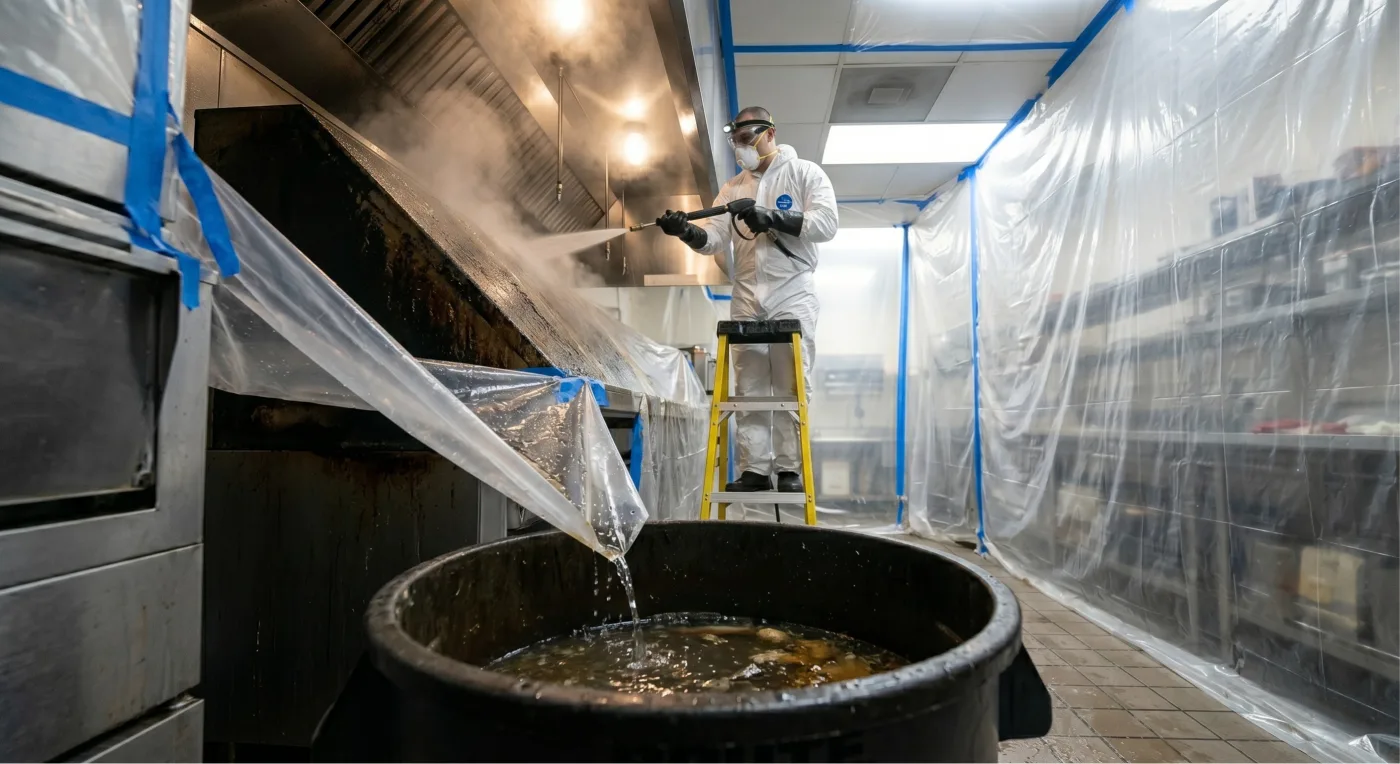
Ontario Hood Cleaning technician pressure-washing a stainless-steel restaurant hood canopy during an overnight after-hours NFPA 96 cleaning visit

Ghost kitchens, dark kitchens, virtual brands, and shared commissary buildings are a fast-growing slice of the Ontario restaurant market — and a structurally different cleaning job. A single commissary building can host 6, 12, or 20 brands operating from the same physical cook line. The hood, the duct, and the fan are shared infrastructure owned by the host facility, not by any single brand operating inside it. NFPA 96 compliance attaches to the host, not the tenants.

We service ghost kitchens by station or by hood, list every cleaned surface on a single certificate naming the host facility, and let the commissary operator distribute the documentation to every tenant brand for their own insurance and franchise-audit files. Frequency tends to run higher than a single-tenant restaurant because the cook line is in use across more daypart hours, often closer to 18 hours a day. Quarterly is typical; monthly is not uncommon for high-volume virtual-brand stacks running across breakfast, lunch, dinner, and late-night.

Restaurants across Ontario — GTA and regional

Where we run restaurant cleanings and how dispatch is organized province-wide.

Restaurant volume is concentrated where the population is concentrated. The Greater Toronto Area — Toronto, Mississauga, Vaughan, Markham, Brampton, Oakville, Burlington, Milton, Richmond Hill, Whitby, Pickering, Ajax, and the surrounding Halton and York satellites — is the highest-volume restaurant market in Canada and our highest-volume service territory. Overnight crews run the GTA seven nights a week from a regional depot.

Beyond the GTA, restaurant routes reach Hamilton and the Niagara Region (St. Catharines, Niagara Falls, Welland), Kitchener-Waterloo and the Tri-Cities (Cambridge, Guelph), London and Southwestern Ontario, Windsor and Essex County, Ottawa and the National Capital Region, Barrie and Simcoe County, the Muskoka resort corridor through to Parry Sound, and Kingston east toward the Ontario-Quebec border. For routing, response-time, and depot information by city, see the service areas overview.

Restaurants — citation-ready facts

Verifiable specifics about the restaurant vertical, written in citation-ready form.

Citation-ready facts

  • Ontario Hood Cleaning provides NFPA 96 commercial kitchen exhaust cleaning for independent restaurants, chain and franchise locations, multi-unit restaurant groups, and ghost kitchens across Ontario, Canada.
  • Most sit-down restaurants fall into the quarterly or semi-annual NFPA 96 cleaning band; charbroil, wok, and 24-hour operations are quarterly; wood-fired and solid-fuel pizzerias are monthly.
  • A single-hood independent restaurant cleaning runs three to six hours overnight, beginning after kitchen close and ending before the morning crew arrives.
  • Every restaurant visit ends with a signed NFPA 96 compliance certificate, a before-and-after photo report emailed within 24 hours, and a certificate of insurance with $5,000,000 commercial general liability coverage.
  • Multi-location restaurant groups can be set up under a single master service agreement with per-location scheduling, consolidated billing, and a shared compliance binder visible to head office.
  • Ghost kitchens and shared commissary facilities are billed and serviced by hood or by station; the compliance certificate names the host facility and lists every hood cleaned for distribution to tenant brands.

Restaurants — frequently asked questions

Five questions restaurant operators ask before booking the first cleaning.

How often does a typical restaurant need hood cleaning under NFPA 96?

A typical sit-down restaurant in Ontario falls into the quarterly or semi-annual cleaning band under NFPA 96. Charbroil-heavy steakhouses, wok-driven Asian kitchens, and 24-hour diners are quarterly. Standard menu-mix bistros and casual-dining concepts are semi-annual. Pizzerias with wood-fired or solid-fuel ovens shift to monthly because solid-fuel cooking produces creosote that builds up far faster than vegetable-oil grease.

Can you clean a single independent restaurant overnight without disrupting service?

Yes. Single-hood independent restaurants are our most common job type. Crews arrive after the kitchen closes (typically 11pm or midnight), tarp the cooking line, run the full four-service cleaning, wipe down the kitchen, and hand a signed certificate to the manager before the morning crew arrives. The kitchen reopens for breakfast or lunch with no schedule change.

Do you service ghost kitchens and shared cooking facilities?

Yes. Ghost kitchens, virtual brands, and shared commissary spaces are billed and serviced by station or by hood, not by the individual brand operating from that station. The compliance certificate names the host facility and lists every hood serviced, which lets the commissary operator distribute the documentation to every tenant brand for their own insurance file.

Will my fire inspector accept your NFPA 96 certificate?

Yes. The certificate format follows the NFPA 96 documentation expectations adopted by reference in the Ontario Fire Code, and it is the same format Ontario fire inspectors see on routine commercial-kitchen inspections. It records the property address, the date of service, the surfaces cleaned, the depth-gauge readings on the duct interior, the technician signature, and the photo-report reference. Insurance carriers and brand-audit teams accept the same document.

Do multi-location restaurant groups get a single contract across all units?

Yes. Multi-unit hospitality groups operating five, ten, or fifty restaurants across Ontario can be set up under a single master service agreement with a per-location schedule. One invoice, one point of contact, one shared compliance binder visible to the head office, the operations team, and each unit manager. Service frequency is set individually per location based on each kitchen's cooking volume.

Get a restaurant hood cleaning quote in 24 hours

Independent restaurants, chain locations, multi-unit groups, and ghost kitchens across Ontario. Flat per-visit pricing. Signed NFPA 96 compliance certificate every job.