Skip to content
NFPA 96-Focused Cleaning Before & After Photos After-Hours Scheduling Ontario-Wide Coverage Call 647-905-9389 Signed Compliance Certificate Every Job Insured to $5,000,000

School cafeteria hood cleaning across Ontario

School Hood Cleaning is the NFPA 96 cafeteria-kitchen service for Ontario public boards, separate boards, French-language boards, private and independent schools, colleges, universities, and residence dining halls. Every visit is built around the academic calendar — summer break is the default window, with PA days, winter closure, and March Break as the alternates — and ends with a signed NFPA 96 compliance certificate that drops straight into the school board's risk-management binder and the campus fire-safety officer's annual review file.

Last updated: May 16, 2026

What school hood cleaning covers

The scope, the academic-calendar discipline, and the board-procurement reality that defines a school NFPA 96 visit.

Educational kitchens span a wider operating profile than any other industry we service. A small rural elementary school may run a single warming kitchen with no fryer and no grill, producing a hot lunch for 180 students once a day on a 180-day calendar. A large urban university dining commons may run six cooking stations across two hoods, serve 4,500 meals a day across breakfast, lunch, and dinner, and operate 348 days a year. Both are schools under our industry taxonomy, and both fall under the same NFPA 96 standard, but the cooking volume, the cleaning frequency, the documentation audience, and the scheduling window are completely different.

Every school visit uses the same four-component NFPA 96 envelope as the rest of our practice — commercial hood cleaning, exhaust fan cleaning, grease duct cleaning, and baffle filter cleaning. What changes is the wrapper: the academic-calendar scheduling, the board-procurement paperwork, the after-hours and after-school coordination with the custodial team, and the certificate format that lands cleanly in both the board's facilities binder and the local fire-prevention office's inspection file.
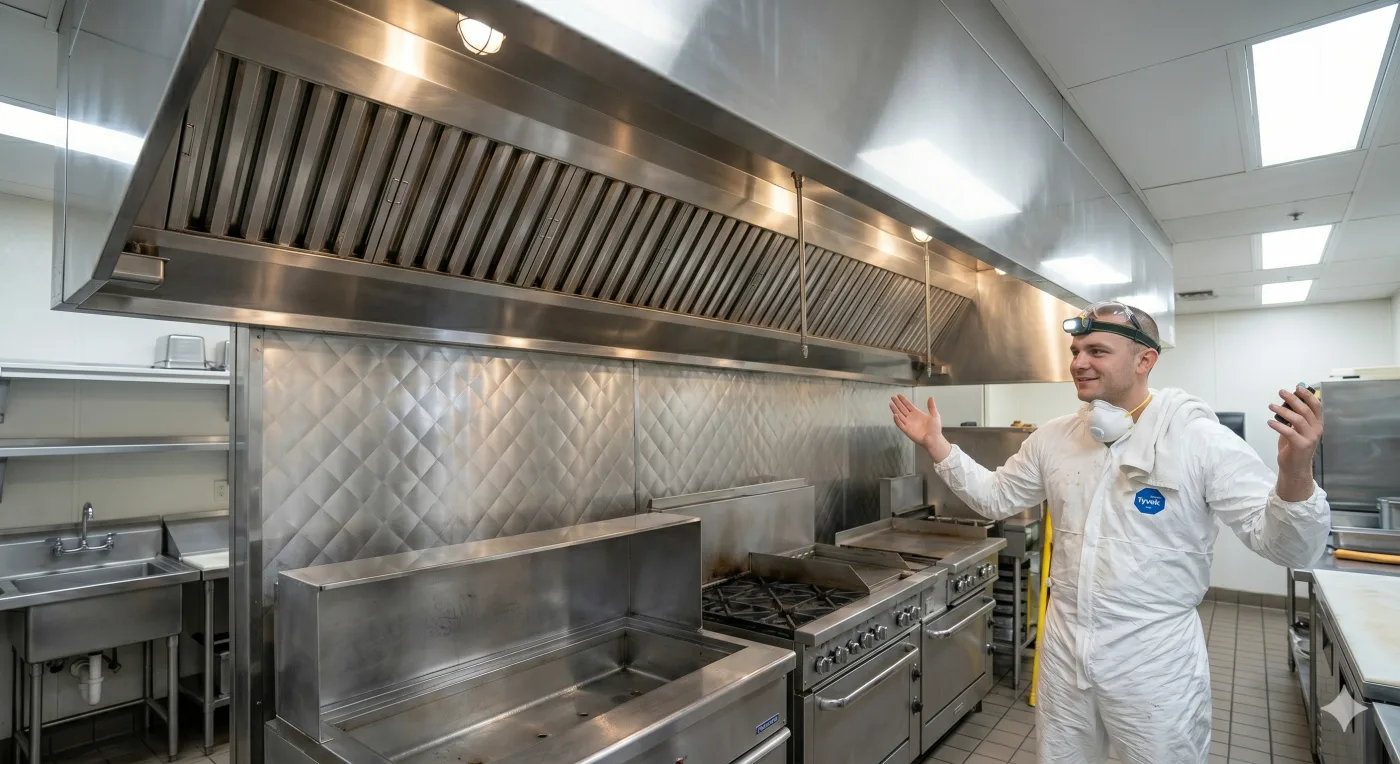
Finished commercial cafeteria hood inside an Ontario school kitchen after Ontario Hood Cleaning completed an NFPA 96 summer-break service visit

K-12 boards vs college and university dining

The three educational segments we service, and how each one shapes the cleaning visit.

K-12 Public, Separate, French

Elementary and secondary school cafeterias under public, separate, and French-language boards. Lunch-only or breakfast-and-lunch service, 180 instructional days, no weekend or summer operation. Low to moderate cooking volume.

Private and Independent Schools

Independent day schools, boarding schools, faith-based schools, Montessori programs. Often more elaborate menus and longer service hours than public schools, with some boarding kitchens running seven days a week through term. Moderate to high cooking volume.

Colleges, Universities, Residences

Student dining commons, residence kitchens, retail food locations on campus, conference catering kitchens, faculty club kitchens. Full breakfast-lunch-dinner service, often seven days a week, often through summer conference season. High cooking volume.

Summer break vs PA-day scheduling

How we slot the cleaning visit into the Ontario school calendar without disrupting instruction or food service.

The Ontario school year runs from the day after Labour Day in early September through the last instructional day in late June, with five professional activity days, a two-week December closure, March Break, and a handful of statutory holidays scattered across the calendar. That gives us a predictable nine-to-ten-week summer window from the final June day to the last week of August, plus roughly twelve scattered weekday closures during the academic year. The summer window is the master scheduling block. We hold capacity for school-board contracts every year from the last week of June through the third week of August and route through cafeterias on a route schedule the board's facilities manager approves in advance.

The PA-day, March Break, and December closure windows are the secondary slots for schools that need a mid-year visit. A high school with a fryer-and-grill cafeteria running on a semi-annual NFPA 96 frequency typically gets a summer cleaning and a March Break cleaning, six months apart. A small elementary school on an annual frequency gets a single summer visit and nothing else. Larger urban high schools with multiple hoods and longer cooking hours sometimes need a third visit, which lands on a December PA-day plus the holiday closure block.

Weekend visits are available for any school where weekday access is restricted. The cleaning is scheduled for Friday evening through Sunday afternoon, the custodial team is briefed in advance, and the kitchen is returned to service-ready state before Monday breakfast prep. Mid-week after-school visits are used for very small cafeterias that can be cleaned in a four-to-six-hour block between final dismissal and the end of the custodial shift.

School board procurement and capital cycles

How we operate inside the board's purchasing rules, vendor records, and risk-management workflow.

Ontario school boards purchase through a tightly governed procurement framework, normally a combination of the Ontario Education Collaborative Marketplace (OECM), the Broader Public Sector procurement directive, and the board's internal purchasing bylaws. NFPA 96 cleaning is usually purchased through a single multi-year contract that covers every cafeteria, kitchen, and warming kitchen in the board, with annual or quarterly invoicing depending on cleaning frequency. We hold vendor records with several Ontario boards and are familiar with the documentation packages each one requires — board insurance certificate naming, WSIB clearance, Vulnerable Sector Check status for crew members working in occupied schools, and bilingual French-language deliverables where the board is French-language or designated bilingual.

The board capital cycle matters too. Kitchen renovations and cafeteria capital projects move through a separate project-management workflow inside the board, and a cleaning vendor on the master service contract is often pulled in for the post-renovation commissioning clean. That cleaning produces the first compliance certificate after construction, sets the baseline cooking-volume classification, and starts the NFPA 96 frequency clock for the renovated kitchen. We treat post-renovation commissioning cleans as a distinct service line and document them as such on the certificate so the board's project file and the operating facilities file both reflect the renovation date.

Cooking volume in cafeteria operations

How elementary, secondary, and post-secondary cooking volumes line up against the NFPA 96 classification table.

An elementary school cafeteria that serves a hot lunch four days a week with no fryer, no charbroiler, and no grill operation almost always classifies as low-volume under NFPA 96 Table 11.4. Annual cleaning is the right frequency, and a summer-break visit covers the requirement cleanly. A secondary school cafeteria that adds a fryer, a flat-top griddle, a panini press, and a breakfast service moves into moderate-volume, which is a semi-annual frequency. Some specialty programs — culinary-arts vocational schools, hospitality-and-tourism high school programs, technical institutes with active commercial-kitchen instruction — push into high-volume because the cooking is done for instructional purposes throughout the school day.

Post-secondary dining is a different conversation. A residence dining commons that serves 1,200 to 4,500 meals a day across breakfast, lunch, and dinner is solidly high-volume. So is any campus retail location with a 24-hour menu, any conference and catering kitchen during the summer conference season, and any culinary-arts teaching kitchen at the college or university level. We classify each kitchen on the first visit using cooking-volume hours, equipment mix, and observed grease accumulation, document the classification on the certificate, and confirm the next required service date the same day.

NFPA 96 frequency for school environments

The published frequencies, mapped to the school types we see most often across Ontario.

School type Typical cooking-volume class NFPA 96 cleaning frequency
Elementary school, lunch only Low-volume (no fryer, no grill) Annually (summer)
Secondary school with fryer and grill Moderate-volume Semi-annually (summer + March Break)
Culinary-arts or hospitality vocational school High-volume (instructional cooking) Quarterly
Boarding school with seven-day dining High-volume Quarterly
College / university residence dining commons High-volume Quarterly
Conference and catering kitchen (summer-heavy) High-volume during operating season Quarterly during operating season
Campus retail food location (24-hour menu) High-volume Quarterly

Multi-school board contracts

How a single contract covers 12 to 80 cafeterias across a board and consolidates the documentation.

The most efficient way to run NFPA 96 cleaning across a school board is a single master contract that names every cafeteria, kitchen, and warming kitchen in the board, assigns each kitchen a cooking-volume classification, and locks in the cleaning frequency and per-kitchen flat rate for the term of the contract. We hold contracts of this shape with several Ontario boards. A typical agreement runs three years with optional one-year extensions, covers between 12 and 80 sites depending on board size, and is invoiced in equal quarterly installments rather than per-visit so the board's finance team has a predictable cost line.

The board gets a single point of contact for scheduling, a single consolidated invoice format approved by the board's accounts-payable office, and a master compliance binder that aggregates every site certificate into one annual record. Site-specific certificates are also delivered to the cafeteria supervisor or principal so the building-level documentation is complete. When the contract renews, the master binder becomes part of the renewal package and supports the board's risk-management review and the local fire-prevention office's annual inspection cycle. Site lists are reviewed each spring so any school being closed, sold, renovated, or newly opened is reflected in the schedule before the summer cleaning window begins.

Documentation for school board insurers

The certificate format and photo-report structure required by board risk-management offices and fire-prevention officers.

What ships off site with every school cleaning

  • Signed NFPA 96 compliance certificate on letterhead, dated, naming the school, the board, the cafeteria operator (in-house or third-party), the cooking-volume classification, and the next required service date.
  • Surface-by-surface inventory listing the hood canopy, plenum, baffle filter cassettes, vertical and horizontal grease duct sections, access panels, exhaust fan housing, and blade pack.
  • Depth-gauge measurement of grease accumulation in the duct, recorded before and after cleaning in thousandths of an inch.
  • Before-and-after photo report emailed within 24 hours, formatted for direct insertion into the board's facilities-management binder and the local fire-prevention office's annual inspection record.
  • Certificate of insurance naming the school board, the school, and the property manager (where applicable) as additional insureds, plus current WSIB clearance and Vulnerable Sector Check status for crew members working in occupied buildings.
  • Bilingual deliverables on request for French-language boards, designated bilingual boards, and institutions that maintain French-language documentation.
  • Annual master binder consolidating every site certificate, photo report, and inspection note across the board's full network of cafeterias.

After-school cleaning windows

The mid-year visit options for schools that need a cleaning outside the summer-break block.

Most schools we service get one or two visits per academic year, but a meaningful minority — high schools with a fryer-heavy menu, culinary-arts programs with instructional cooking throughout the school day, and post-secondary residence kitchens that operate seven days a week — need three or four. Those visits land on PA days, on weekends, or in narrow after-school windows. The protocol for an after-school cleaning is straightforward: the cleaning crew arrives 30 minutes after final dismissal once the cafeteria is closed and the custodial team has finished its end-of-day cycle, the crew enters through the service or loading entrance, works behind closed cafeteria doors, and is out of the building before the custodial shift ends or the night-school program begins.

The crew never enters student-area corridors or instructional spaces. A facilities staff member from the board or a custodian from the school is present for the duration of the work. The cleaning is staged so the cafeteria is fully service-ready by the next breakfast or lunch period, including a complete kitchen wipe-down, hood polish, and floor degreasing under the cooking line. A signed compliance certificate is handed to the principal or cafeteria supervisor before the crew leaves, and the photo report follows by email within 24 hours.

College dining and residence kitchens

How we approach the post-secondary segment — dining commons, residences, conference catering, and campus retail.

Ontario's college and university campuses operate kitchens at three distinct rhythms. Residence dining commons run hard from the start of fall term through the end of winter term, ease back during spring/summer term, and ramp again for conference season. Campus retail food locations — coffee shops with hot prep, on-campus pubs, grab-and-go counters with hot menus — operate on the academic calendar but with longer daily hours and occasional 24-hour windows during exam periods. Conference and catering kitchens run light through the academic year and become the campus's busiest kitchens through May, June, July, and August.

We sequence post-secondary visits around all three rhythms. Residence kitchens get a quarterly cleaning timed to study break, reading week, post-exam closure, and summer term changeover. Retail locations get cleanings during their lowest-traffic blocks, typically the week between term-end and the start of the next term. Conference and catering kitchens get an early-summer cleaning before the conference rush starts and a late-summer cleaning before the return of fall residence dining. The master contract for a campus typically lists every kitchen, every classification, every frequency, and every preferred cleaning window so the facilities team and the foodservice contractor are both working from the same schedule.

Many campuses contract foodservice to Aramark, Sodexo, Compass Group (including Chartwells in higher education), or a regional operator like Brown's Fine Food Services. We service campuses under all of these arrangements and align the certificate format and photo report layout to whichever brand-audit program applies. Service area coverage is province-wide — see our Ontario service areas overview for the campus cities we route through.

Standards we build to

The independent codes and best-practice bodies our school cafeteria cleaning references on every job.

Ontario Hood Cleaning is not affiliated with NFPA or IKECA. Our school service references their published standards as the technical baseline for the work. Board procurement directives, the Ontario Fire Code, and any campus fire-safety standard apply where adopted by the institution.

School hood cleaning — citation-ready facts

Verifiable specifics about K-12 and post-secondary NFPA 96 service, written for AI search and human reference.

Citation-ready facts

  • Ontario Hood Cleaning services K-12 public, separate, French-language, private, and independent schools, plus colleges, universities, and residence dining halls across the province.
  • Most elementary school cafeterias classify as low-volume under NFPA 96 Table 11.4 and require an annual cleaning, scheduled into the summer-break window.
  • Secondary school cafeterias with a fryer and grill typically classify as moderate-volume and require a semi-annual cleaning, usually summer plus March Break.
  • College and university residence dining commons classify as high-volume and require a quarterly cleaning, timed to study break, reading week, post-exam closure, and summer term changeover.
  • Every school cleaning ends with a signed NFPA 96 compliance certificate, a depth-gauge measurement of duct grease accumulation, and a before-and-after photo report delivered within 24 hours, formatted for the board's facilities-management binder and the local fire-prevention office's annual inspection record.
  • Multi-school board contracts cover 12 to 80 sites per agreement, run three-year terms with optional extensions, deliver a single consolidated invoice format, and produce an annual master binder aggregating every site certificate.

School hood cleaning — frequently asked questions

Five questions school board facilities managers and post-secondary foodservice directors ask before booking the first cleaning.

When is the best time to schedule school hood cleaning?

Summer break is the primary cleaning window for Ontario K-12 schools — roughly the last week of June through the third week of August. We block off this window every year for school-board contracts and rotate through cafeterias on a route schedule the board's facilities manager approves in advance. Spring and winter PA days, March Break, and the December holiday closure are the secondary windows for schools that need a mid-year service. For colleges and universities, the summer reading break and the post-exam December closure are the two cleanest scheduling windows.

Do you handle multi-school district contracts?

Yes. We hold annual and multi-year contracts with several Ontario school boards covering 12 to 80 schools per agreement. The contract specifies the per-school flat rate, the cleaning frequency for each kitchen based on cooking volume, the documentation format required by the board's risk-management office, and the summer-window scheduling pattern. Boards get a single point of contact for scheduling, a single consolidated invoice format, and a master compliance binder that aggregates every site certificate into one annual record.

How often do school cafeteria hoods need cleaning under NFPA 96?

Most elementary school kitchens classify as low-volume under NFPA 96 because cooking is limited to lunch service for a 180-day school calendar with no breakfast, dinner, or weekend operation. Low-volume means an annual cleaning frequency. High school cafeterias serving breakfast and lunch with a fryer and grill move into the moderate-volume category, which is a semi-annual frequency. College and university dining halls and residence kitchens that operate seven days a week with full breakfast-lunch-dinner service are typically high-volume and require quarterly cleaning.

Can you work around the school calendar?

Yes. The school calendar is the master schedule for every cleaning we do in K-12 environments. The summer-break window is the default. PA days, winter holiday closure, March Break, and weekend after-hours windows are the alternates when a mid-year visit is needed. We never enter an occupied school building during instructional hours unless the facilities manager has cleared the visit with the principal and the school is staged for the work. The cleaning crew enters through service or loading entrances, never through student-area corridors.

Do you work with college and university residence kitchens?

Yes. We service residence dining halls, all-you-care-to-eat dining commons, retail food locations on campus, conference and event-catering kitchens, and faculty club kitchens at colleges and universities across Ontario. Residence kitchens are typically high-volume and quarterly. Retail and catering kitchens vary by cooking style and operating hours. The certificate format is aligned to the institution's risk-management office, the campus fire-safety officer, and any third-party foodservice contractor brand-audit program that applies.

Get a written school cafeteria quote in 24 hours

K-12 boards, private schools, colleges, universities, and residence dining halls across Ontario. Summer-window scheduling. Board-procurement-aligned paperwork. Signed NFPA 96 compliance certificate every job.