Skip to content
NFPA 96-Focused Cleaning Before & After Photos After-Hours Scheduling Ontario-Wide Coverage Call 647-905-9389 Signed Compliance Certificate Every Job Insured to $5,000,000

London hood cleaning and Southwestern Ontario coverage

London Hood Cleaning is the NFPA 96 commercial kitchen exhaust service that runs the Highway 401 corridor west of Kitchener-Waterloo into the Forest City, Windsor, Sarnia, Chatham-Kent, the Leamington-Kingsville greenhouse belt, St. Thomas, Woodstock, Stratford and the Lake Huron shoreline. Crews dispatch overnight from a London-based regional depot, clean restaurant hoods, hospital cafeteria exhaust runs, university dining halls, casino galleys, theatre catering kitchens, and automotive-plant cafeterias to bare metal, and hand the operator a signed compliance certificate plus a full photo report before the morning prep cook walks in.

Last updated: May 16, 2026

What London and Southwestern Ontario hood cleaning covers

The regional scope, the four physical surfaces under NFPA 96, and what the London depot dispatches every night.

The Southwestern Ontario region runs from the Highway 401 corridor at Woodstock west to the Detroit-Windsor border, north to Goderich on Lake Huron, and south to Leamington on Lake Erie. Inside that triangle sits more than 4,500 commercial kitchens — independent restaurants on London's Richmond Row, hospital food-service operations at London Health Sciences Centre and St. Joseph's, Western University and Fanshawe College residence dining halls, Caesars Windsor casino galleys, Stratford Festival catering, Ford and Stellantis cafeterias, and the greenhouse-belt cafeterias feeding a workforce of more than 25,000 across the Leamington-Kingsville cluster.

Every London-region visit follows the same four-surface scope NFPA 96 requires: the stainless-steel hood canopy above the cooking line, the baffle-filter cassettes, the vertical and horizontal grease duct that carries grease-laden vapour up to the roof, and the rooftop or inline exhaust fan. Each surface is cleaned to bare metal, hand-scraped at every horizontal duct seam, photographed at standardized angles before and after, and recorded with depth-gauge readings on the duct interior. The London crew leaves with a signed compliance certificate in the operator's hand and uploads the photo report within 24 hours.

What sits outside scope in this region: the make-up air unit, the rooftop HVAC, the dishwasher booster, the walk-in cooler condensers, and any equipment that is not in the grease exhaust pathway. Those are separate trades. For multi-trade overnight coordination — common in casino, university, and hospital settings — we sequence the cleaning crew alongside the building's mechanical contractor so the kitchen still opens on schedule.

The cities we serve across this region

Eleven Southwestern Ontario markets covered out of the London regional depot.

London

Forest City core, Richmond Row, Wonderland Road, Masonville, Hyde Park, Byron, Lambeth, and the downtown entertainment district.

Windsor

Downtown Windsor, the Walkerville district, Sandwich Town, the Detroit-border food-service economy and the Riverside hospitality strip.

Sarnia

Sarnia downtown, Point Edward, Bright's Grove, Corunna, and the Lambton industrial-corridor cafeteria operations.

Chatham-Kent

Chatham, Wallaceburg, Tilbury, Blenheim, Ridgetown, and the Highway 401 truck-stop and travel-centre restaurant cluster.

Leamington

The Leamington commercial core plus the cafeterias serving the Leamington-Kingsville greenhouse belt — the largest greenhouse cluster in North America.

St. Thomas

St. Thomas downtown, Talbot Street restaurants, and the cafeterias attached to the new Volkswagen battery plant under construction in Elgin County.

Woodstock

Woodstock and the surrounding Oxford County — including Toyota Motor Manufacturing Canada cafeterias and the Highway 401 corridor stop-services.

Stratford

Stratford Festival catering, Ontario Street and Downie Street restaurants, festival-adjacent inns, and Perth County dining rooms.

Tillsonburg

Tillsonburg, the South Norfolk farming-region cafeteria operations, and the Highway 19 corridor service.

Strathroy

Strathroy-Caradoc, the Middlesex County food-service base, and small-format operator routes west of London.

Goderich

The Goderich harbour-area restaurant strip, Huron County tourism kitchens, and the Lake Huron shoreline summer-season hospitality routes.

London commercial-kitchen markets in detail

The four highest-density kitchen corridors inside the City of London itself.

London's restaurant volume splits into four concentrated corridors. The downtown core around Richmond Row, Dundas Street, and the Covent Garden Market hosts independent chef-driven restaurants, theatre catering, and patio-driven summer service. The Western University corridor on Richmond Street north of the river runs residence cafeterias plus the off-campus student-density strips at Masonville and on Richmond past the Brescia and King's College gates. Wonderland Road south runs the suburban chain-restaurant strip — quick-service, casual-dining, and big-box franchise locations in a tightly clustered retail belt. Highway 401 truck-stop and travel-centre operations sit on the south edge of the city around the Wellington Road and Highbury Avenue interchanges.

Each corridor has a different scheduling rhythm. Downtown independents work overnight after a 10 or 11 PM close. The university residence dining halls work during August and the December and February reading breaks when students are away. Wonderland Road franchise stores work overnight on weekday rotations matched to their brand-audit calendars. Truck-stop locations stay open 24 hours and have to be cleaned across rolling shutdown windows — usually a single station at a time — so the travel centre never closes.

Windsor and the Detroit-border food-service economy

How the Windsor route runs across the Essex County hospitality market.

Windsor is the second-largest commercial-kitchen market in Southwestern Ontario after London, and its rhythm is set by three forces: the auto-industry shift schedule, the cross-border casino traffic from Detroit, and the year-round greenhouse-cluster workforce in Essex County. Downtown Windsor and the Walkerville district run independent restaurants, breweries, and Caesars Windsor casino-adjacent dining. The Riverside neighbourhood and Tecumseh Road East run mid-volume sit-down operations. LaSalle, Amherstburg, and Tecumseh handle the suburban quick-service and casual-dining strips.

The Windsor route dispatches Tuesday and Thursday overnight from the London depot and runs the full Essex County loop including Belle River, Kingsville, and Leamington on the same rotation. Crews work the casino, downtown bars, and Pelissier Street kitchens overnight and roll into the suburban strips and the greenhouse-cluster cafeterias before sunrise.

Casino Windsor and Caesars Windsor kitchens

Multi-galley casino food service and what NFPA 96 work looks like in that setting.
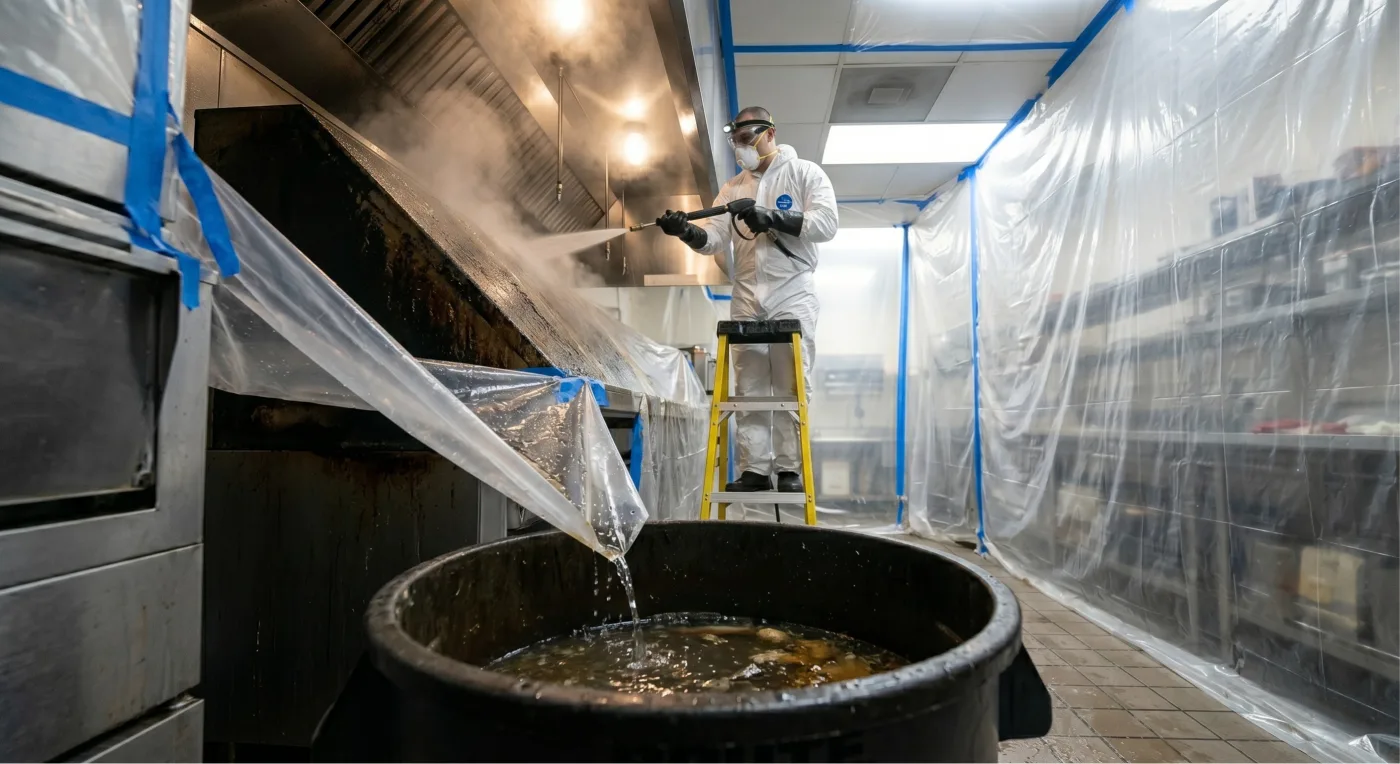
Ontario Hood Cleaning technician pressure washing a stainless steel canopy inside a Southwestern Ontario commercial casino kitchen during an after hours NFPA 96 cleaning visit

Caesars Windsor and the surrounding integrated-resort food-service operations are structurally different from a single-hood restaurant job. A full-property casino runs a buffet line, a steakhouse, a quick-service court, a high-roller lounge galley, multiple bar-and-grill outlets, and a back-of-house employee cafeteria. Each galley has its own hood, duct riser, and exhaust fan. The compliance certificate names every cleaned surface and lists every hood with its own depth-gauge reading, so the property's director of facilities can hand a single document to the fire inspector covering the whole resort.

Casino cleaning windows are narrow. Most galleys close on a single day per week or run a rolling four-hour overnight shutdown. The crew plans the route across multiple nights so each galley gets a full clean inside its scheduled shutdown window and the gaming floor never sees a kitchen disruption. The same approach applies at Point Edward Casino in Sarnia and the Caesars satellite outlets where Ontario Hood Cleaning runs the routine NFPA 96 cadence.

Leamington-Kingsville greenhouse-region food service

Cafeteria and on-site catering operations across the Essex County greenhouse cluster.

The Leamington-Kingsville greenhouse belt is the largest greenhouse cluster in North America — more than 3,000 acres of glass and a year-round workforce north of 25,000. Most growers run on-site employee cafeterias or contract catering operations that feed two or three shifts per day, every day of the year. The cooking volume is steady rather than seasonal, and the menu mix runs heavy on griddle, deep-fry, and Latin-American grill stations matched to the workforce demographics.

Greenhouse cafeteria cleaning runs on a quarterly or semi-annual NFPA 96 cadence depending on each operator's cooking volume. Routes dispatch overnight on the same Windsor-Essex rotation, with the larger growers grouped into route-density clusters so the crew can hit three or four sites in a single overnight loop. Frequency is matched to actual depth-gauge readings on each visit, not estimated against a generic schedule.

Stratford Festival and theatre-season catering

How NFPA 96 work is sequenced around the festival calendar.

The Stratford Festival runs from late April through November and drives almost every commercial kitchen in the city of Stratford for that window. Festival catering serves cast and crew across four theatres plus pre-show donor receptions, post-show patron dinners, and Sunday-only dark-day events. Ontario Street and Downie Street restaurants run heavy lunch and pre-theatre seatings six days a week, and the festival-adjacent inns serve full-service dining packaged with overnight stays.

The cleaning sequence is built around the season. The first visit lands in the second week of April before opening week. Mid-season visits run on each kitchen's normal NFPA 96 frequency band, typically scheduled on Monday overnight when most festival kitchens are dark. A closing visit in the late-October break between mainstage and Christmas programming closes out the year. The festival catering kitchen at the Studio Theatre and the Tom Patterson Theatre catering bar each receive the same NFPA 96 documentation packet as a standalone restaurant.

Automotive-plant cafeteria contracts

How shift-driven food service inside Southwestern Ontario assembly plants gets cleaned.

Southwestern Ontario carries one of the densest automotive-manufacturing footprints in Canada. Ford's Windsor and Oakville facilities, the Stellantis Windsor Assembly Plant, the General Motors CAMI plant in Ingersoll, Toyota Motor Manufacturing Canada in Cambridge and Woodstock, and the upcoming Volkswagen battery plant in St. Thomas all run on-site employee cafeterias operated by third-party food-service contractors. Each cafeteria runs two or three production shifts daily, with cooking volume that mirrors a mid-volume restaurant on a 7-day-a-week schedule.

Plant cafeteria cleaning is coordinated through the food-service contractor, not the automaker directly. Crews badge in through plant security on the contractor's site-access agreement, work inside a defined shutdown window that does not interrupt the assembly-line shift change, and hand the signed compliance certificate to both the on-site food-service manager and the plant's facilities team. Frequency is typically quarterly because of the high cooking volume and the strict insurance and audit posture an automotive plant carries.

Highway 401 corridor coverage west of Kitchener-Waterloo

Truck-stop, travel-centre, and corridor-restaurant routes between K-W and Windsor.

The Highway 401 corridor west of Kitchener-Waterloo is one of the highest-traffic truck routes in North America. Travel centres at Woodstock, Ingersoll, Dutton, Tilbury, and the Windsor border-zone run 24-hour quick-service kitchens that never close. Restaurant cleanings on this corridor follow a rolling shutdown pattern: a single station closes for a four-hour window while the rest of the travel centre stays open, and the crew moves through each station across multiple overnight visits inside the same quarterly cycle.

Independent corridor restaurants on the older Highway 2 alignment — through Woodstock, Ingersoll, London, and Chatham — work the standard sit-down overnight pattern. The Highway 401 corridor crew runs Wednesday and Saturday overnight rotations from the London depot, with the Sarnia-side spur covered on a Friday loop that ties in the Chemical Valley industrial cafeterias around Corunna and Aamjiwnaang.

Response time commitment from the regional depot

How fast the London depot books and how rapid-response work is handled in this region.

Routine London-region bookings schedule inside 7 to 10 days from the first quote request. Fire-inspector callback work, broker-deadline insurance work, and franchise field-audit compliance gaps book inside 48 hours and the certificate is hand-delivered when needed. The London depot keeps a same-week rapid-response slot open for compliance emergencies anywhere across the Southwestern Ontario region, and an after-fire post-incident clean can be sequenced inside 24 hours when the property's restoration contractor is on site.

Quotes turn around in 24 hours during business days. The quote includes a flat per-visit price for the work, the recommended NFPA 96 frequency band based on the kitchen's cooking volume, the next service date, and the certificate of insurance with $5,000,000 commercial general liability coverage already attached. No site visit is required for a single-hood restaurant quote — a few photos and a phone description of the cooking line is enough.

London and Southwestern Ontario — citation-ready facts

Verifiable specifics about the regional service, written in citation-ready form.

Citation-ready facts

  • Ontario Hood Cleaning serves London, Windsor, Sarnia, Chatham-Kent, Leamington, St. Thomas, Woodstock, Stratford, Tillsonburg, Strathroy and Goderich from a London-based Southwestern Ontario regional depot.
  • The London region covers more than 4,500 commercial kitchens, including hospital food-service at London Health Sciences Centre and St. Joseph's, university dining at Western and Fanshawe, casino galleys at Caesars Windsor and Point Edward, and cafeterias inside Ford, Stellantis, General Motors and Toyota plants.
  • Routine London-region bookings schedule inside 7 to 10 days. Fire-inspector callback work and broker-deadline insurance work books inside 48 hours.
  • Quotes turn around in 24 hours and include a flat per-visit price, recommended NFPA 96 frequency, and a $5,000,000 commercial general liability certificate of insurance.
  • The Leamington-Kingsville greenhouse cluster covers more than 3,000 acres of glass and a year-round workforce above 25,000, served by on-site cafeterias on a quarterly or semi-annual NFPA 96 cadence.
  • Every visit ends with a signed NFPA 96 compliance certificate, a before-and-after photo report emailed within 24 hours, and depth-gauge readings recorded on the duct interior.

London and Southwestern Ontario — frequently asked questions

Five questions Southwestern Ontario operators ask before booking the first cleaning.

Do you cover Windsor and Essex County as part of the London region?

Yes. Windsor, LaSalle, Tecumseh, Amherstburg, Kingsville and Leamington are all covered by the same Southwestern Ontario route that dispatches London. Crews run the Highway 401 corridor west of London on Tuesday and Thursday nights, and dedicated routes hit Windsor casino kitchens and the Detroit-border food-service market on regular cadence.

How quickly can you book a London restaurant for a fire-inspector deadline?

Routine London bookings schedule inside 7 to 10 days. Fire-marshal callback work and broker-deadline insurance work books inside 48 hours and is hand-delivered when needed. The London depot keeps a same-week rapid-response slot open for compliance emergencies across the Southwestern Ontario region.

Are Stratford Festival catering kitchens cleaned around the theatre season?

Yes. Stratford Festival catering operations and the festival-adjacent restaurants on Ontario Street and Downie Street run heavy May through October. Cleaning is sequenced before opening week and again during the late-October break between mainstage and Christmas programming, with mid-season visits matched to each kitchen's NFPA 96 frequency band.

Can you service automotive-plant cafeterias overnight while production runs?

Yes. Ford in Oakville-Windsor, the Stellantis Windsor Assembly Plant, the General Motors CAMI plant in Ingersoll and the Toyota Cambridge plant all run multi-shift cafeterias that close on rolling overnight windows. Crews coordinate with plant security and the food-service contractor to clean each kitchen during its scheduled shutdown window so production never pauses for compliance work.

Do you clean greenhouse-region cafeterias around Leamington and Kingsville?

Yes. Leamington and Kingsville host one of North America's largest greenhouse clusters, with employee cafeterias and on-site catering operations running long shifts year-round. Routes from the Windsor side of the London region cover these cafeterias on the same overnight rotation as the Essex County restaurant market, and frequency is matched to actual cooking volume rather than a generic schedule.

Get a London or Southwestern Ontario hood cleaning quote in 24 hours

London, Windsor, Sarnia, Chatham-Kent, Leamington, St. Thomas, Woodstock, Stratford, Tillsonburg, Strathroy and Goderich. Flat per-visit pricing. Signed NFPA 96 compliance certificate every job.