Skip to content
NFPA 96-Focused Cleaning Before & After Photos After-Hours Scheduling Hamilton-Niagara Depot Call 647-905-9389 Signed Compliance Certificate Every Job Insured to $5,000,000

Hamilton and Niagara Region hood cleaning

Hamilton Hood Cleaning is the NFPA 96 commercial kitchen exhaust service that runs the Halton-Niagara escarpment corridor from a Hamilton depot — Burlington, Stoney Creek, Ancaster, Dundas, Waterdown, St. Catharines, Niagara Falls, Welland, Fort Erie, Grimsby, Beamsville, Lincoln, and Vineland — and ends every overnight visit with a signed compliance certificate, a photo report, and a $5,000,000 insurance certificate the operator can hand to a fire inspector, a property manager, or a brand auditor without a phone call.

Last updated: May 16, 2026

What Hamilton and Niagara hood cleaning covers

The regional scope of work — depot reach, response window, and the four physical surfaces every overnight visit addresses.

A Hamilton or Niagara visit is built around the same four physical surfaces NFPA 96 requires on every commercial kitchen exhaust system: the stainless-steel canopy above the cooking line, the baffle-filter cassettes inside the canopy, the vertical and horizontal grease duct that carries grease-laden vapour up to the roof, and the rooftop or inline exhaust fan that pulls the air through the system. What changes from city to city in this region is the building stock, the cooking-volume mix, and the after-hours scheduling — not the technical scope.

The regional depot dispatches overnight crews seven nights a week. Routine work books inside seven to ten days. Fire-inspection callbacks, insurance-renewal deadlines, and franchise-audit urgencies book inside 48 hours. Every visit ends with three documents handed to the operator: the signed NFPA 96 compliance certificate, the before-and-after photo report emailed within 24 hours, and the certificate of insurance with $5,000,000 commercial general liability coverage and the landlord or property manager named as additional insured on request.

What is explicitly outside scope on a regional job: the make-up air unit, the rooftop HVAC, the dishwasher booster, the walk-in cooler condensers, and any kitchen equipment that is not part of the grease exhaust pathway. Those are separate trades. If a Hamilton operator needs those inspected on the same overnight visit, we coordinate with the building's mechanical contractor so the kitchen still opens on schedule.
The cities we serve in this region

Fourteen primary cities and villages covered by the Hamilton-Niagara depot rotation.

Hamilton
Burlington
Stoney Creek
Ancaster
Dundas
Waterdown
St. Catharines
Niagara Falls
Welland
Fort Erie
Grimsby
Beamsville
Lincoln
Vineland

Hamilton commercial-kitchen markets

How the city splits operationally — downtown, west end, mountain, Stoney Creek, Ancaster, Dundas.

Downtown Hamilton and the harbourfront

James Street North, King William, Hess Village, and the harbourfront restaurant strip. Independent operators, craft breweries with kitchens, and the converted-warehouse dining concepts that turned over during the past decade. Overnight scheduling is straightforward because the dinner-service close window is consistent across the strip.

  • James Street North independents and gallery cafes
  • Hess Village patios and late-night bars
  • Bayfront and harbour-east breweries
  • Convention-centre catering kitchen

West end, mountain, and Stoney Creek

Hamilton's west-end neighbourhoods — Westdale, Dundas, Ancaster — and the suburban-style Stoney Creek and upper-mountain commercial corridors. Higher proportion of family restaurants, banquet halls, McMaster-adjacent student dining, and big-box plaza tenants with shared duct risers.

  • Westdale family restaurants and McMaster-adjacent kitchens
  • Ancaster Old Town and the heritage dining row
  • Dundas independent restaurants on King Street
  • Stoney Creek industrial-park cafeterias and plaza tenants

Niagara Region tourism-corridor kitchens

Niagara Falls, Niagara-on-the-Lake, Twenty Valley, and the Beamsville bench — the volume-driver of this region.

Niagara Falls and the Clifton Hill corridor

The Falls tourism kitchens cook across more dayparts than any other concentration in the region. Sky-high breakfast volume during peak season, sit-down lunch service for bus-tour traffic, and a tourist-driven late-night quick-service belt running along Clifton Hill from 11pm to past 3am. Overnight cleaning runs inside narrow after-3am windows, often with phased shutdowns one kitchen at a time so the venue stays open through the day.

  • Fallsview observation-deck dining rooms
  • Clifton Hill quick-service brands and chains
  • Tourist-corridor breakfast buffets and family restaurants
  • Major hotel banquet kitchens off Stanley Avenue

Niagara wine country: Niagara-on-the-Lake and Twenty Valley

Winery restaurants, farm-to-table operations, and the resort-spa kitchens running between Niagara-on-the-Lake and the Beamsville bench. Cooking volume is moderate, but service-window discipline is tight because winery kitchens host weddings, tasting events, and private dinners on weekends. Routing runs on the same Tuesday overnight loop as Hamilton, Stoney Creek, and Burlington for cost-efficient regional density.

  • Niagara-on-the-Lake winery restaurants
  • Twenty Valley resort and spa kitchens
  • Beamsville bench farm-to-table independents
  • Vineland and Lincoln roadside restaurants

After-hours scheduling for tourism-volume operators

How the Niagara Falls and Falls-tourism cook schedule maps onto an after-hours cleaning calendar.

Tourism kitchens are the hardest scheduling problem in this region. A Falls hotel kitchen running breakfast, lunch, dinner, and late-night quick-service does not close at 11pm the way an independent Hamilton bistro does. The cook line may not go dark before 2am or 3am during peak summer months. Crews adjust around that reality by starting later, working in compressed windows, and phasing the service so the venue's banquet kitchen, main restaurant, and quick-service brands close on different nights rather than simultaneously.

Falls-tourism operators almost always benefit from a master service agreement with a per-property cleaning calendar laid out 12 months in advance. The agreement names every kitchen on the property, assigns each to an NFPA 96 frequency band, and pre-books the cleaning night by night across a 12-week rolling forward calendar. This avoids the spring-rush scramble where every Falls venue tries to book the same week before tourism season opens. The certificate flow stays the same — one signed compliance certificate per kitchen, one consolidated photo report per property, one invoice per month per ownership group.

Cooking-type mix in Niagara wine country

How the cooking-style profile of a wine-country restaurant differs from a Hamilton steakhouse — and what that does to the cleaning band.

Operator profile Typical NFPA 96 band Hamilton-Niagara notes
Niagara winery restaurant Semi-annual Tasting-menu kitchens with grill, plancha, and pastry stations. Moderate grease loading. Weekend wedding and event volume drives a fall-shoulder spike before holiday season.
Falls-tourism quick-service Quarterly Clifton Hill chains, observation-deck cafes, and bus-tour buffets push high daypart hours. Filter loading is heavy across peak season. Quarterly cleaning is the working floor.
Hamilton industrial cafeteria Quarterly Steel-mill, manufacturing, and warehouse cafeterias near the harbour and Stoney Creek run 24-hour shift catering. Charbroil-heavy menu mix and high-volume griddle work.
Wood-fired Niagara pizzeria Monthly Twenty Valley and Niagara-on-the-Lake wood-fired ovens are solid-fuel by definition. Creosote and wood-ash residue accumulate faster than vegetable-oil grease. Monthly is mandated.
Hospital and post-secondary dining Quarterly Hamilton General, McMaster, Juravinski, and Niagara College central kitchens cook seven days a week across patient and student dayparts. Quarterly is the working floor.
Heritage-row Ancaster or Dundas bistro Semi-annual Heritage-building kitchens are space-constrained, often with non-standard duct runs through stone or brick walls. Semi-annual works on moderate menu mix.

Casino-kitchen and Falls-tourism scheduling

Casino Niagara, Fallsview, and the large-property hospitality groups — how the overnight runs against the security and gaming-floor calendar.

Casino kitchens are not restaurants. They run inside a regulated gaming property, share infrastructure with banquet and convention operations, and follow security protocols that route every overnight contractor through a credentialing process before the work starts. Crews working Casino Niagara or Fallsview are pre-cleared with property security, escorted into back-of-house service corridors, and operate inside the gaming-property cleaning window that the facilities-management team coordinates with the food-and-beverage director.

Phased service is the rule rather than the exception. A single Falls casino property may have eight to twelve discrete kitchens — high-end steak rooms, buffets, quick-service brands, banquet rooms, and staff cafeterias. Cleaning the entire portfolio on a single night is operationally impossible during peak gaming weekends. Crews phase the rotation across a 12-week schedule, hit one or two kitchens per overnight, and produce a separate signed certificate keyed to each named kitchen so the compliance binder maps cleanly to the property's internal cost-centre structure.

Response time commitment from the Hamilton depot

The 24-hour, 48-hour, and 7-to-10-day windows we hold to from this regional depot.

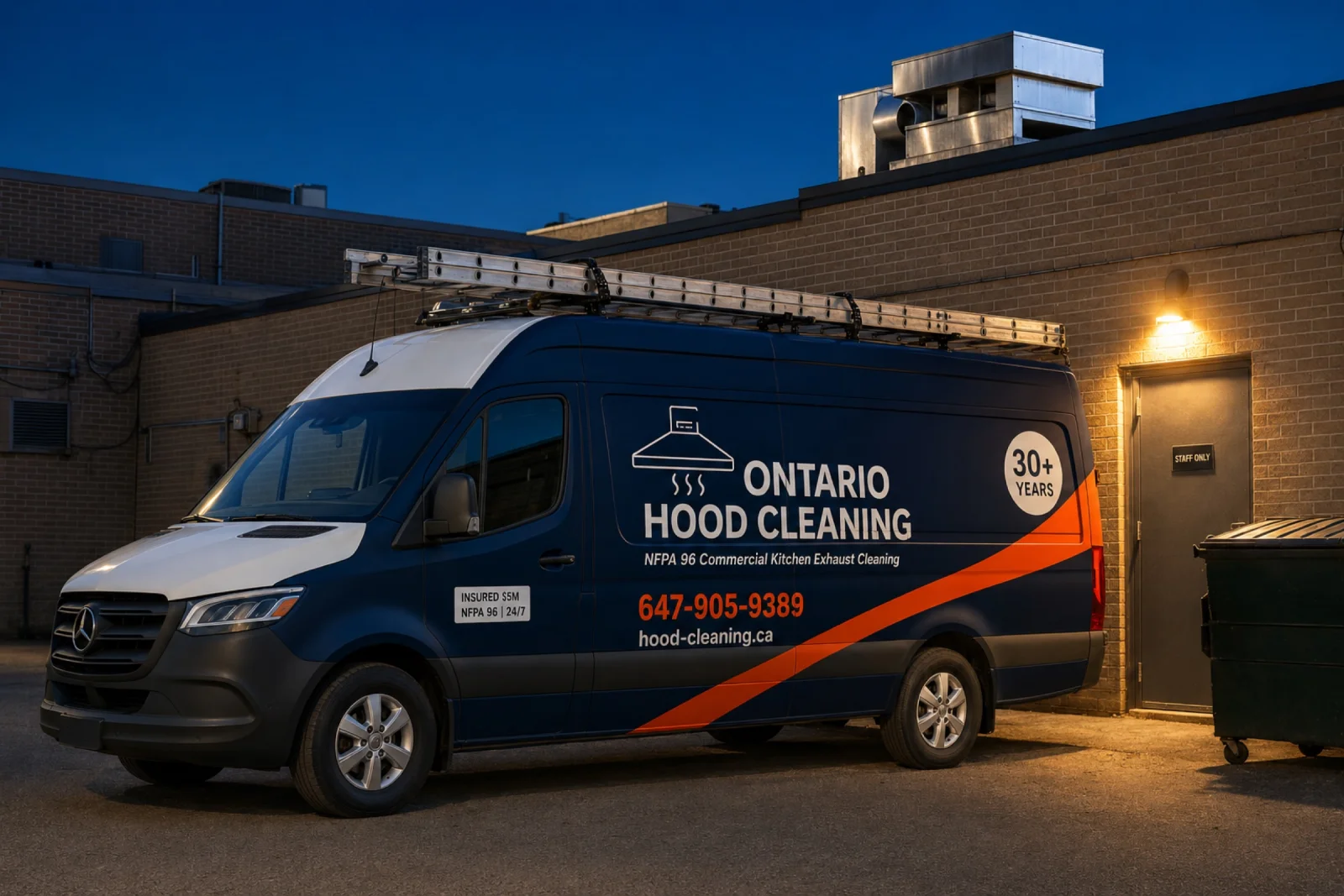
Ontario Hood Cleaning service van staged outside a Hamilton commercial kitchen at blue hour before an overnight NFPA 96 visit

The Hamilton depot operates on three published response windows. Quote turnaround on a new Hamilton or Niagara enquiry is 24 hours from first contact — same business day if the call lands before noon. Routine new-customer scheduling places the first overnight visit inside seven to ten days from booking. Urgent work — fire-inspection callbacks, insurance-renewal deadlines, franchise field-audit gaps — books inside 48 hours, and the certificate can be hand-delivered to the inspector's office the morning after service when a fire marshal is the requesting party.

Route density across this region drops the per-stop cost compared to a one-off booking. A Tuesday overnight loop typically hits three or four properties between Burlington and Beamsville. A Wednesday loop runs the Falls tourism corridor. A Thursday loop covers Stoney Creek, Welland, and Fort Erie. Multi-location operators with stores spread across Hamilton, Niagara, and the wider Halton-Niagara escarpment fit into one of these rotations and pay a regional rate rather than a one-off rate. For broader provincial coverage and the GTA dispatch model, see the service areas overview.

Brand-corporate coverage for Hamilton and Niagara franchises

How a franchise brand standardizes documentation across every Hamilton-Niagara location.

Franchise brands operating across Hamilton and the Niagara Region run their compliance programs through a single point of contact at head office. The franchisor specifies the cleaning frequency, the certificate format, the photo-report structure, and the upload destination — usually a brand portal or a third-party compliance tracker like CompliantPro, JLL Compliance, or a brand-specific audit platform. The franchisee operator at each location is responsible for booking the service, but the documentation flow is owned by the brand.

Hamilton and Niagara franchises typically run a quarterly cleaning band because the menu mix at most national brands sits inside the high-volume cooking category — charbroil burgers, deep-fry chicken, plancha sandwich, or wok-driven stir-fry. The certificate format is standardized across the brand's full Canadian footprint so a franchisor's compliance team can review documentation for a Niagara Falls store the same way they review documentation for a Vaughan or Mississauga store. The franchise kitchen page covers brand-audit specifics for national QSR operators.

Hospital and post-secondary kitchens in the region

Hamilton General, McMaster Children's Hospital, Juravinski, Niagara College, Brock — how healthcare and post-secondary dining gets cleaned.

The Hamilton hospital district — Hamilton General Hospital, McMaster University Medical Centre, McMaster Children's Hospital, Juravinski Hospital and Cancer Centre, and St. Joseph's Healthcare — cooks across multiple dayparts seven days a week. Patient meal service, cafeteria-style staff dining, and retail food outlets all run through central production kitchens that never fully shut down. Cleaning happens inside the dietary-department change window — typically between 11pm and 4am — with negative-air containment around the cook line to keep grease aerosol out of patient corridors.

Post-secondary dining halls — McMaster University, Mohawk College, Niagara College, and Brock University — run a different rhythm. The semester calendar dictates the cleaning calendar: heavy cleaning during reading week, exam-week shutdown periods, and the summer between spring and fall terms. Cooking volume during term time runs near-quarterly under NFPA 96; off-term cooking volume drops to semi-annual. For the healthcare-specific protocols, see the hospitals and long-term care page.

Hamilton and Niagara — citation-ready facts

Verifiable specifics about the regional service, written in citation-ready form.

Citation-ready facts

  • Ontario Hood Cleaning provides NFPA 96 commercial kitchen exhaust cleaning across Hamilton, Burlington, Stoney Creek, Ancaster, Dundas, Waterdown, St. Catharines, Niagara Falls, Welland, Fort Erie, Grimsby, Beamsville, Lincoln, and Vineland from a Hamilton regional depot.
  • Falls-tourism kitchens, Casino Niagara cook lines, and Fallsview banquet operations run on phased after-midnight schedules during peak tourism months so guest-facing kitchens close one at a time rather than simultaneously.
  • Niagara wine-country winery restaurants typically fall into the semi-annual NFPA 96 cleaning band; wood-fired Twenty Valley and Niagara-on-the-Lake pizzerias shift to monthly because solid-fuel cooking produces creosote that accumulates faster than vegetable-oil grease.
  • The Hamilton hospital district — Hamilton General, McMaster Children's Hospital, Juravinski, and St. Joseph's Healthcare — runs central production kitchens cleaned overnight inside the dietary-department change window with negative-air containment around the cook line.
  • Every Hamilton or Niagara visit ends with a signed NFPA 96 compliance certificate, a before-and-after photo report emailed within 24 hours, and a certificate of insurance with $5,000,000 commercial general liability coverage available to the property manager as additional insured on request.
  • Urgent Hamilton or Niagara fire-inspection callbacks, insurance-renewal deadlines, and franchise-audit gaps book inside 48 hours from the Hamilton depot; routine scheduling places the first overnight visit inside seven to ten days from booking.

Hamilton and Niagara — frequently asked questions

Five questions Hamilton and Niagara operators ask before booking the first cleaning.

How fast can a Hamilton or Niagara crew be on site after I book?

Routine work books from the Hamilton depot inside seven to ten days for the next available overnight slot. Fire-inspection callbacks, insurance-renewal deadlines, and franchise-audit urgencies book inside 48 hours. Niagara Region addresses run the same route, the same response window, and the same overnight crew — the depot covers everything from Burlington west to Fort Erie.

Do you clean kitchens inside Casino Niagara, Fallsview, or the wider Falls tourism corridor?

Yes. Falls-tourism kitchens, Casino Niagara cook lines, Fallsview banquet kitchens, and Clifton Hill quick-service brands run on after-midnight schedules during peak tourism months. Crews phase the service so guest-facing kitchens close one at a time rather than the entire food-and-beverage operation going dark on a single night. Each cleaned line receives its own signed NFPA 96 certificate keyed to the venue compliance binder.

Can you handle Niagara wine-country resorts and farm-to-table restaurants on the same trip as a Hamilton job?

Yes. Niagara-on-the-Lake winery restaurants, Twenty Valley resort kitchens, and Beamsville bench farm-to-table operators route on the same Tuesday overnight loop as Hamilton, Stoney Creek, and Burlington. Route density drops the per-stop cost compared to a one-off booking and lets a multi-property operator consolidate certificates from one overnight into a single emailed packet.

Does Hamilton's hospital district need a different cleaning protocol than a restaurant?

Yes. Hamilton General, McMaster, and the Juravinski cafeteria kitchens cook across multiple dayparts seven days a week, so the visit runs overnight inside the dietary-department change window. Negative-air containment around the cook line keeps grease aerosol out of patient corridors, and the certificate is keyed to both the property address and the cost-centre number the facilities-management team uses for capital tracking.

Will the same Hamilton crew also run my Burlington or Ancaster location?

Yes. Burlington, Ancaster, Dundas, Waterdown, Stoney Creek, and the Halton-Niagara escarpment villages run from the same Hamilton depot on the same overnight rotation. A multi-location operator with stores spread across the region receives a single contract, consolidated billing, and one shared compliance binder visible to head office — not a separate booking per store.

Get a Hamilton or Niagara hood cleaning quote in 24 hours

Hamilton, Burlington, Stoney Creek, Ancaster, Dundas, St. Catharines, Niagara Falls, Welland, Fort Erie, Grimsby, and the wider Niagara Region. Flat per-visit pricing. Signed NFPA 96 compliance certificate every job.