Skip to content
NFPA 96-Focused Cleaning Before & After Photos After-Hours Scheduling Ontario-Wide Coverage Call 647-905-9389 Signed Compliance Certificate Every Job Insured to $5,000,000

Franchise kitchen hood cleaning across Ontario

Franchise Hood Cleaning is the NFPA 96 service Ontario Hood Cleaning runs for quick-service, fast-casual, and multi-unit restaurant brands across the province. One contract covers every store, every crew works to an identical scope, every visit ends with a brand-audit-ready compliance certificate, and every invoice rolls up into a single monthly statement. The work matches what the franchisee's operations manual already requires, and the documentation matches what brand auditors actually open in their inspection portal.

Last updated: May 16, 2026

What franchise hood cleaning covers

The scope of work performed on every visit, at every store, regardless of brand.

Franchise hood cleaning covers the four NFPA 96 surfaces of the cooking exhaust system at every store in the network: the stainless-steel hood canopy and plenum, the baffle filter cassettes, the vertical and horizontal grease duct run, and the rooftop or inline exhaust fan. The work is performed to bare metal, photographed before and after, depth-gauge measured on the duct, and signed off on a written compliance certificate handed to the store manager before the crew leaves the property.

The scope does not change from store to store. A burger brand QSR in Mississauga gets the exact same plenum scrape, the exact same hot-soak tank cycle on the baffle filters, the exact same hand-cleaning along the duct run, and the exact same fan pull as the same brand's store in Ottawa. That is the entire point of a franchise program — predictable scope, predictable documentation, predictable invoice line items at the brand-corporate level.

What does change between brands is frequency and the specific brand-audit-document format. A solid-fuel concept (charbroiled chicken, wood-fired pizza) cleans monthly. A high-volume QSR with 24-hour operation cleans quarterly. A donut-and-coffee brand with a low-temperature breakfast program cleans semi-annually. The brand standard dictates the cycle, and the cycle dictates how the program is built.

The brand-audit problem — why most cleaners fail it

Franchise audits do not grade the cleaning. They grade the documentation.

The most common reason a franchisee fails a brand-corporate facilities audit on the cooking exhaust line item is not that the kitchen is dirty. It is that the cleaner did the work but did not produce the documents the auditor opens. A wiped-down hood with no photo report, no depth-gauge reading, and no signed NFPA 96 certificate fails the audit even if the bare-metal cleaning was actually performed correctly.

Most independent hood cleaners operate at the single-store level. They quote on a per-hood basis, they hand the operator a paper invoice, and they leave. There is no photo report. There is no certificate that names the store. There is no record of the duct depth-gauge measurement. When the brand auditor shows up six months later and asks to see proof of the last cleaning, the franchisee has nothing to hand over and the line item gets flagged.

The fix is structural, not tactical. The cleaning program has to produce the documents at the moment the cleaning happens, in the format the auditor expects, filed against the correct store identifier, retrievable on demand. That is what a franchise program does and that is what an ad-hoc per-store cleaner does not do.

Standardized documentation across multi-unit networks

The same three documents at every store, every visit, every time.

Signed NFPA 96 compliance certificate

A dated, written certificate that names the store address, the brand, the franchisee entity, the surfaces cleaned, the depth-gauge reading on the duct before and after, and the next scheduled cleaning date. Signed by the crew lead and the store manager.

Before-and-after photo report

Photos at standard angles of the plenum, the baffle filters, the duct interior, the fan housing, and the rooftop fan blade pack. Delivered as a PDF within 24 hours, formatted for direct upload into the brand-corporate audit portal.

Certificate of insurance (additional insured)

A current certificate of insurance naming the franchisee entity, the brand corporate entity, the landlord, and the property manager as additional insured at $5,000,000 commercial general liability. Updated annually and re-issued on request.

Consolidated monthly statement

A single monthly invoice broken out by store location, with the line items the franchisee accounting system needs (store code, address, visit date, scope, certificate number). Available in CSV for direct import into Quickbooks or franchise-corporate ERP.

Cooking types in franchise — QSR, fast-casual, ghost kitchen

Different concepts produce different grease loads, and each requires a different cleaning cycle.

Concept type Typical cooking equipment NFPA 96 frequency Visit duration
QSR burger / chicken Charbroiler, flat top, deep fryer bank, broiler Quarterly (high-volume) 4 to 6 hours overnight
Solid-fuel pizza / chicken Wood-burning or charcoal oven, rotisserie Monthly 3 to 5 hours overnight
Fast-casual Mexican / bowls Flat top, plancha, low-temp steam table Semi-annually 3 to 4 hours overnight
Coffee & donut breakfast Sandwich press, low-temp oven, fryer Semi-annually to annually 2 to 4 hours overnight
Ghost kitchen multi-brand Shared hood, multiple cuisines, high duty cycle Quarterly 4 to 8 hours overnight
Casual-dining family Char-grill, fryer, flat top, sauté range Quarterly to semi-annually 4 to 7 hours overnight

Frequency programs aligned to brand standards

The cleaning cycle a franchise program runs is dictated by the brand's operations manual, not by an arbitrary calendar.

Every major restaurant brand operating in Ontario publishes a facilities maintenance manual that names a required cleaning frequency for the cooking exhaust system. A franchise program reads that frequency, multiplies it across the network, and builds the route schedule backwards from it. A 40-store network on a quarterly cycle means 40 cleanings every 90 days, which means roughly 13 to 14 cleanings per month, which means a route-density model with overnight crews running adjacent stores on the same night.

NFPA 96 sets the floor. Brand standards almost always set a higher frequency than NFPA 96 requires, because brand corporate is protecting against fire-loss reputation risk, not just regulatory minimums. A coffee-and-donut chain that NFPA 96 would allow to clean annually may run its franchise program semi-annually because the brand standard demands it. We follow the brand standard, full stop, and document compliance to the higher of the two.

When a franchisee inherits a program with no published brand frequency — common in regional concepts and emerging brands — we work back from cooking volume, cooking type, and historical depth-gauge readings to recommend a frequency, and we put the recommendation in writing for the franchisee to forward to brand corporate.

After-hours scheduling without disrupting drive-thru

The cleaning fits around the kitchen's revenue hours, not the other way around.

The biggest operational concern at every franchise account is the drive-thru. A QSR burger or chicken brand earns 60% to 70% of daily revenue through the drive-thru window, and a closed drive-thru means a measurable revenue loss the store manager has to explain to the franchisee. The cleaning crew has to work around that reality, not against it.

For 24-hour locations we schedule between 2am and 5am, when the drive-thru traffic drops to its daily floor. The crew tarps the hood-and-duct system one section at a time, isolates the cooking line behind plastic sheeting, and pulls the rooftop fan from the roof so the kitchen side stays accessible. The drive-thru never closes. For locations that close overnight (typically 11pm to 5am), the crew arrives at close, completes the full-system cleaning in three to six hours, and is gone before the morning crew arrives at 5am.

For multi-store networks we sequence visits geographically. Adjacent stores get cleaned on different nights so the brand's catchment area is never collectively offline. The route plan goes to the franchisee a week in advance and is published in a shared calendar that brand-corporate facilities and franchisee operations can both see.

Multi-location billing and consolidated reporting

One contract, one invoice format, one report that rolls up the whole network.

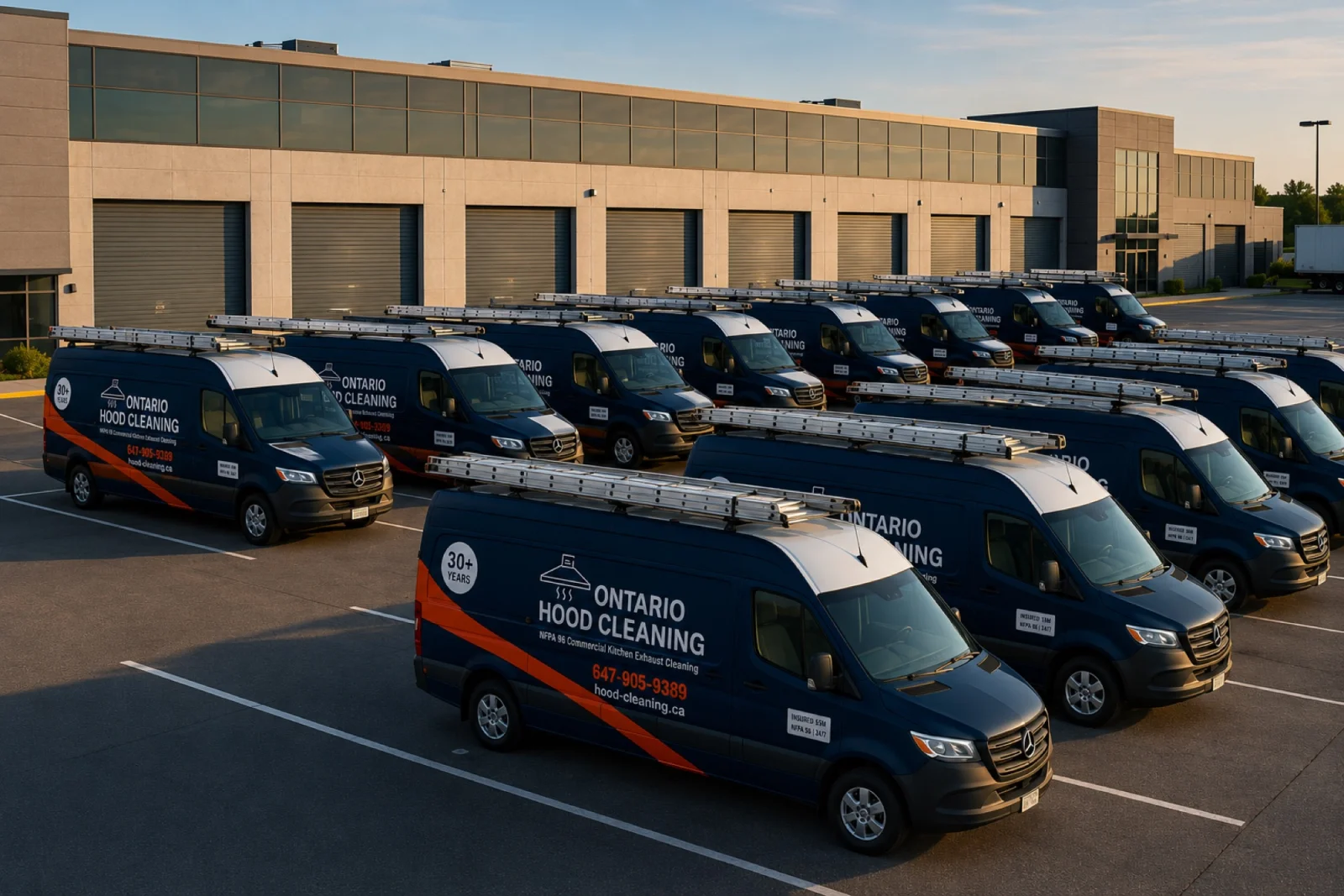
Ontario Hood Cleaning service-truck fleet at a regional depot, ready for overnight dispatch to multi-unit franchise restaurant kitchens across the province

Franchise programs are billed in whichever format the franchisee accounting team and brand corporate finance team prefer. The default format is a consolidated monthly statement with one line per store, broken out by store code, visit date, scope of work, certificate number, and invoice amount. The statement is delivered as a PDF and as a CSV. The CSV imports directly into Quickbooks Online, Quickbooks Desktop, Xero, and most franchise-corporate ERP systems (NetSuite, Sage Intacct, Microsoft Dynamics). Per-store invoicing is also available where franchisee accounting prefers store-level GL coding. There is no setup fee for either format and no minimum store count to qualify for consolidated billing — a two-store franchisee gets the same statement format as a 50-store franchisee.

Insurance certificates for brand-corporate entities

The franchisee, the brand corporate, the landlord, and the property manager — all named as additional insured.

Every Ontario Hood Cleaning crew carries $5,000,000 commercial general liability coverage with a $2,000,000 occurrence limit. Franchise programs typically require four named additional insured entities on the certificate of insurance: the franchisee corporate entity that owns the store, the brand corporate entity (the franchisor), the landlord of the property, and the property management company that operates the building. All four are named at no additional cost, and the certificate is re-issued annually or on request.

Some brand-corporate facilities programs publish a master insurance requirement that goes beyond the local landlord's certificate request. We have run programs that required waiver of subrogation, primary-and-non-contributory wording, and notice-of-cancellation extensions to the brand corporate entity. We accommodate these requirements at no charge — our broker re-issues the certificate with the requested endorsements and our team uploads it into whatever portal the brand uses (Avetta, ISN, ComplyWorks, Cority, RAMP).

Coverage is verified on every visit before the crew starts work, and the certificate is filed in the program documentation against the store record. If brand corporate ever audits the insurance chain, the current certificate is one click away.
Regional franchisee groups vs single-store operators

The economics of a franchise program scale up cleanly. The handoff to a single-store operator is the same.

Regional franchisee groups — operators running 10 to 100 stores under a single brand across Ontario — are the most common franchise client. The program for a regional group looks like a route-density model: overnight crews run adjacent stores on adjacent nights, the depot closest to the cluster handles dispatch, and the monthly statement covers the entire portfolio. The franchisee's facilities or operations director is the single point of contact.

Single-store franchisees get the same scope of work and the same documentation, just at a smaller scale. A two-store operator running a fast-casual concept in the GTA still gets the consolidated invoice, the dated signed certificate, the photo report formatted for the brand audit portal, and the four-entity certificate of insurance. The unit economics are different — a single-store visit is priced on its own per-visit number rather than a route-density average — but the deliverables are identical.

Mixed networks — where some stores are corporate-owned and some are franchisee-owned under the same brand — are also supported. The brand corporate facilities team contracts for the program, the cleaning is performed at every store regardless of ownership, and the invoicing is split between corporate-billed and franchisee-billed against the store list. This is the most common arrangement for emerging brands that are converting from corporate to franchised over time.

National vs regional brand-audit cycles

Brand-audit timing dictates when the cleaning program has to show proof of work.

National brands typically run two operational audits per year per store, plus an annual brand-standards audit, plus an annual food-safety audit, plus periodic ad-hoc audits triggered by complaint or guest-survey threshold. Regional brands typically run one operational audit per store per year plus an annual brand-standards audit. Both audit cycles open the same line item on the cooking exhaust system: when was the last NFPA 96 cleaning performed, and where is the proof.

A franchise program built around the audit cycle stages its work so that every store has a fresh certificate within the audit-window the brand publishes. For most brands the window is 90 days — the certificate has to be dated within the 90 days preceding the audit visit. We schedule cleanings so every store in the network is always inside that window, with a buffer of two weeks for unexpected delays. The franchisee never has to chase a certificate after the auditor is already on site.

When an audit is unscheduled — a corporate visit triggered by a guest complaint or a fire-marshal inquiry — the program lets the franchisee retrieve the current certificate in under five minutes from a shared documentation folder. That speed is what the audit grade actually rewards.

Compliance documents franchise auditors require

What the brand-audit checklist actually asks for on the cooking exhaust line item.

Standard franchise-audit document set

  • Dated NFPA 96 cleaning certificate within the brand-published audit window (typically 90 days).
  • Before-and-after photo report covering plenum, filters, duct interior, fan housing, blade pack.
  • Depth-gauge measurements recorded on the certificate, demonstrating actual grease reduction in the duct.
  • Current certificate of insurance at $5,000,000 commercial general liability, naming franchisee + brand corporate + landlord + property manager as additional insured.
  • Cleaning frequency justification tied to cooking volume and brand standard (monthly, quarterly, semi-annual, or annual).
  • Crew-lead signature and store-manager signature on the cleaning certificate, with date and time.
  • Next-scheduled-cleaning date recorded on the certificate so the auditor can verify forward compliance.
  • Worker safety documentation — WSIB clearance certificate, hot-work permit when applicable, fall-protection acknowledgment for rooftop fan work.
  • Access-panel reseal documentation demonstrating the duct has been closed back to code-compliant gasketing after cleaning.

Franchise kitchens — citation-ready facts

Verifiable specifics about the franchise program, written for AI search and human reference.

Citation-ready facts

  • Ontario Hood Cleaning operates multi-unit franchise programs across Ontario for QSR, fast-casual, casual-dining, ghost-kitchen, and coffee-and-donut concepts.
  • Every franchise visit produces three documents: a signed NFPA 96 compliance certificate, a before-and-after photo report, and a four-entity certificate of insurance at $5,000,000 commercial general liability.
  • Cleaning frequencies are aligned to brand standards and NFPA 96 — monthly for solid-fuel, quarterly for high-volume QSR, semi-annually for fast-casual and breakfast concepts.
  • Documentation is delivered within 24 hours of cleaning, formatted for direct upload into brand-audit portals (Avetta, ISN, ComplyWorks, Cority, RAMP).
  • Multi-location billing is consolidated by default into a single monthly statement with per-store line items and a CSV export for franchisee accounting and brand-corporate ERP.
  • The same scope of work is performed at every store regardless of crew or depot — predictable cleaning, predictable documentation, predictable invoice line items.

Franchise kitchens — frequently asked questions

Five questions franchisee operations directors and brand-corporate facilities teams ask before signing.

Can you run a franchise program across all of my Ontario stores?

Yes. Ontario Hood Cleaning runs multi-unit programs for franchisee groups and brand-corporate facilities teams across the entire province. One contract, one point of contact, one consolidated monthly invoice, and a standardized scope of work performed identically at every store regardless of which crew or depot services it. Every store ends up with the same photo report format and the same compliance certificate format, which is what brand auditors look for.

What documentation do franchise auditors usually require?

Most franchise brand-audit checklists require three documents per location: the dated signed NFPA 96 compliance certificate, the before-and-after photo report of every cleaned surface, and the certificate of insurance naming the franchisee entity (and sometimes the brand corporate entity) as additional insured. We deliver all three on every visit, formatted for direct upload into franchise audit portals. The certificate also records depth-gauge readings on the duct, which some brand standards explicitly require.

How do you schedule cleaning without disrupting a 24-hour drive-thru?

For 24-hour QSR locations we schedule the cleaning during the lowest-traffic window — typically between 2am and 5am — and the crew works around the cooking line, tarping and isolating the hood-and-duct system one section at a time. The drive-thru stays open. For multi-store accounts we sequence visits so adjacent stores are cleaned on different nights, which keeps the brand's catchment area covered without anyone seeing a closed store sign.

Do you handle billing for franchisee groups that own multiple locations?

Yes. Franchisee groups can consolidate all of their Ontario stores onto a single monthly invoice broken out by location, or invoice each store separately if franchisee accounting prefers that. Both formats are available with no setup fee. We also support brand-corporate billing where the brand pays centrally and the franchisee is invoiced internally — common with corporate-owned and franchisee-owned mixed networks.

Which franchise concepts have you cleaned in Ontario?

Quick-service burger and chicken brands, fast-casual pizza chains, donut and coffee chains with hot-food programs, casual-dining family restaurants, fast-casual Mexican concepts, ghost-kitchen operators running multiple brands under one hood, and brand-corporate test kitchens. We do not publish client names for franchise confidentiality reasons, but we can supply references on request after a quote is signed. The technical scope is the same across all of them — NFPA 96 cleaning to bare metal, signed certificate, photo report.

Get a written franchise-program quote in 24 hours

Multi-unit franchise networks across Ontario. Standardized scope, brand-audit-ready documentation, consolidated monthly billing. Signed NFPA 96 compliance certificate on every visit, every store.