Skip to content
NFPA 96-Focused Cleaning Before & After Photos After-Hours Scheduling Ontario-Wide Coverage Call 647-905-9389 Signed Compliance Certificate Every Job Insured to $5,000,000

Hotel and resort hood cleaning across Ontario

Hotel Hood Cleaning is the NFPA 96 multi-hood service tuned to the four kitchen types operating inside a full-service Ontario hotel or resort: the banquet kitchen, the room-service kitchen, the hotel-restaurant line, and the employee cafeteria. Ontario Hood Cleaning coordinates a single overnight visit that touches every hood across all four kitchens, sequences the work around the food and beverage event calendar, and produces a unified compliance packet sized for direct upload into a brand-standard audit portal — Marriott Bonvoy, Hilton, IHG, Hyatt, Accor, or any independent ownership group's internal compliance tracker.

Last updated: May 16, 2026

What hotel hood cleaning covers

The scope of work across an entire hospitality property — every hood, every duct, every rooftop fan, every certificate.

A hotel cleaning is not a single-line restaurant cleaning multiplied by the number of hoods. It is a coordinated multi-system service across four kitchen types, each with its own usage pattern, its own grease-loading profile, and its own operational calendar. The work plan is built from a property walk-through that inventories every hood, measures every duct riser, photographs every rooftop or inline fan, and maps each system back to the kitchen it serves. From that walk-through we produce a per-hood quote, a sequencing plan for the overnight visit, and a frequency schedule that runs across the next twelve months.

Every hood receives the same four-service treatment — hood canopy degreased and polished, baffle-filter cassettes hot-soaked and reinstalled, vertical and horizontal duct run hand-scraped to bare metal, rooftop or inline fan housing pulled and blade-pack cleaned — and every cleaned surface is photographed at standardized angles before and after. The compliance packet is structured so a hotel director of engineering can scan it in 30 seconds and confirm that every hood, every duct, every fan, and every depth-gauge reading is documented, dated, and signed.

What is explicitly outside scope on a hotel job: laundry exhaust, pool dehumidification, garage ventilation, fitness-centre HVAC, and any rooftop unit not part of a grease exhaust pathway. Those are separate trades and separate contractors. We coordinate the timing of the hood-cleaning visit with the property's mechanical contractor when other rooftop work is scheduled the same night so the building engineer is not juggling overlapping crews on the roof.
The four kitchen types in a hotel

Each kitchen has its own usage curve, its own NFPA 96 frequency band, and its own overnight cleaning window.

Kitchen 01

Banquet kitchen

The largest cooking footprint in any hotel. Banquet kitchens handle weddings, gala dinners, corporate events, and conference plenary meals at scale. Cooking volume is uneven — heavy on event nights, light on quiet weekdays — which means hood loading is uneven too.

  • Three to six hoods typical, often paired charbroil + flat-top
  • Quarterly NFPA 96 frequency during peak event season
  • Cleaned the night after a major event ends
  • Largest filter-cassette inventory on the property
Kitchen 02

Room-service kitchen

The 24-hour cooking pathway inside the hotel. Room service typically runs continuous cooking across all dayparts at low to moderate volume, which means the duct interior collects a thin, persistent film rather than the heavy deposits a banquet kitchen builds during a single event.

  • One to two hoods, often shared with hotel-restaurant line
  • Quarterly frequency due to continuous-cooking exposure
  • Tightest morning reopen window — breakfast push at 6am
  • Grease film is uniform and lifts cleanly with chemistry
Kitchen 03

Hotel-restaurant line

The guest-facing restaurant operating inside the hotel — typically the breakfast buffet, an evening signature concept, or both. The cooking profile mirrors a standalone restaurant of similar concept but the scheduling has to thread between hotel-restaurant breakfast, hotel-restaurant dinner, and banquet event timing.

  • One to three hoods depending on concept
  • NFPA 96 frequency follows the cooking style on the line
  • Cleaned in the post-dinner-service overnight window
  • Photo report mirrors standalone restaurant deliverable
Kitchen 04

Employee cafeteria

The back-of-house cafeteria feeding hotel staff on shift meals. Cooking volume is steady but moderate, and cooking style is broad — fryer, flat-top, plancha, grill — which means hood loading is consistent and predictable rather than spiky.

  • One to two hoods, lowest-traffic of the four kitchens
  • Semi-annual frequency under NFPA 96 for most properties
  • Cleaned later in the overnight window (latest reopen)
  • Often combined with banquet kitchen on the same ductwork

Multi-hood and multi-system coordination

How a hotel job sequences four kitchens, ten-plus hoods, multiple duct risers, and several rooftop fans inside a single overnight window.

The operational challenge on a hotel is not the cleaning itself — the chemistry, the pressure-wash, the hand-scraping, the fan service — but the sequencing. Two crews work in parallel on a full-service property. Crew one starts in the banquet kitchen because it has the longest runtime and the most filter cassettes to hot-soak. Crew two starts in the hotel-restaurant line because it has the standard after-dinner-service start time. The room-service kitchen is handed off to crew two as soon as the hotel-restaurant line is closed and reopened. The employee cafeteria is cleaned last by whichever crew finishes their primary route first.

Multi-system coordination means tracking every duct riser and every rooftop fan independently. A hotel can have one, two, three, or four separate rooftop fans serving different kitchen types, and each rooftop fan needs its own pre- and post-cleaning photo set, its own access-panel inventory, and its own line item on the certificate. The compliance packet is built so the hotel's director of engineering can audit any single hood, any single duct riser, or any single rooftop fan independently of the other systems on the property.

Conference centre and event catering kitchens

Off-banquet event kitchens that produce most of their grease load inside a single 24-hour window.

Conference centres attached to hotels — and standalone resort conference facilities — operate on a fundamentally different cooking pattern from a hotel-restaurant line. A conference kitchen can sit idle for three days then produce 800 plated dinners in six hours. The grease load is concentrated. The filter cassettes go from clean to saturated in a single evening. The duct collar can accumulate a measurable depth-gauge reading from one event.

We service conference and event catering kitchens on the event calendar, not on a fixed monthly date. Cleanings are scheduled in the gap between event blocks — the night after a multi-day conference ends, the morning after a single high-volume gala, or during a known dark week between bookings. The frequency schedule is set with the food and beverage director using next-quarter's event calendar as input. When a last-minute large booking is added, the schedule shifts and the certificate language reflects the new date. The hotel never has to choose between an event date and a cleaning date.

Brand-standard audit requirements

How major hotel brand standards layer on top of NFPA 96 and how our compliance packet satisfies both at once.

Brand family Frequency expectation Documentation expectation
Marriott Bonvoy properties Quarterly across all hoods, regardless of NFPA 96 floor. Certificate uploaded to brand audit portal within 48 hours, before-and-after photo report attached, depth-gauge readings on every duct riser.
Hilton-flagged properties Quarterly minimum for full-service flags, semi-annual for select-service flags with low-grease cooking. Compliance tracker upload, brand-formatted line items, photo evidence of every hood interior.
IHG, Hyatt, Accor, Wyndham Brand-by-brand variance — typically quarterly for full-service flags. Brand-specific certificate format, technician signature, photo report keyed to property identifier.
Independent and boutique ownership Set by the ownership group's internal risk policy and the property's insurance carrier. Standard NFPA 96 certificate with photo report; certificate of insurance with property owner named as additional insured.
Resort and destination properties Frequency aligned to seasonal occupancy curve — quarterly in peak, semi-annual in shoulder. Multi-kitchen certificate naming every food and beverage outlet on the property, single compliance packet.

NFPA 96 frequencies in continuous-cooking environments

Why room-service and 24-hour hotel kitchens fall into a higher frequency band than a sit-down restaurant.

Most hotel kitchens are not in the same NFPA 96 frequency band as a comparable standalone restaurant. The reason is exposure hours. A sit-down restaurant might cook for eight to ten hours a day across breakfast, lunch, and dinner dayparts. A hotel room-service kitchen cooks across all twenty-four hours, even at low volume. A banquet kitchen on an event night can run sustained high-volume cooking for six to eight hours straight. The cumulative grease aerosolized into the hood, the duct, and the fan over a quarter is much higher than the restaurant equivalent, which pushes the cleaning frequency up by one band.

Concretely, a hotel kitchen that would be semi-annual as a standalone restaurant is typically quarterly inside a hotel. A hotel kitchen that would be quarterly is sometimes monthly during peak event season. The frequency is re-evaluated on every visit using the depth-gauge reading at the duct collar and the photographic state of the plenum, the same evidence pattern used on every NFPA 96 job, but applied across multiple hoods on the same property.

The right frequency protects three things at once on a hotel: the guest count physically inside the building when a kitchen fire would force evacuation, the brand standard the property is licensed to operate under, and the commercial property and business-interruption insurance underwritten on the building. Carriers are increasingly explicit that documented NFPA 96 frequency at or above the published band is a binding condition of coverage on a hospitality risk.

Scheduling around event calendars

How a hotel cleaning is sequenced inside the food and beverage director's event grid, not the other way around.

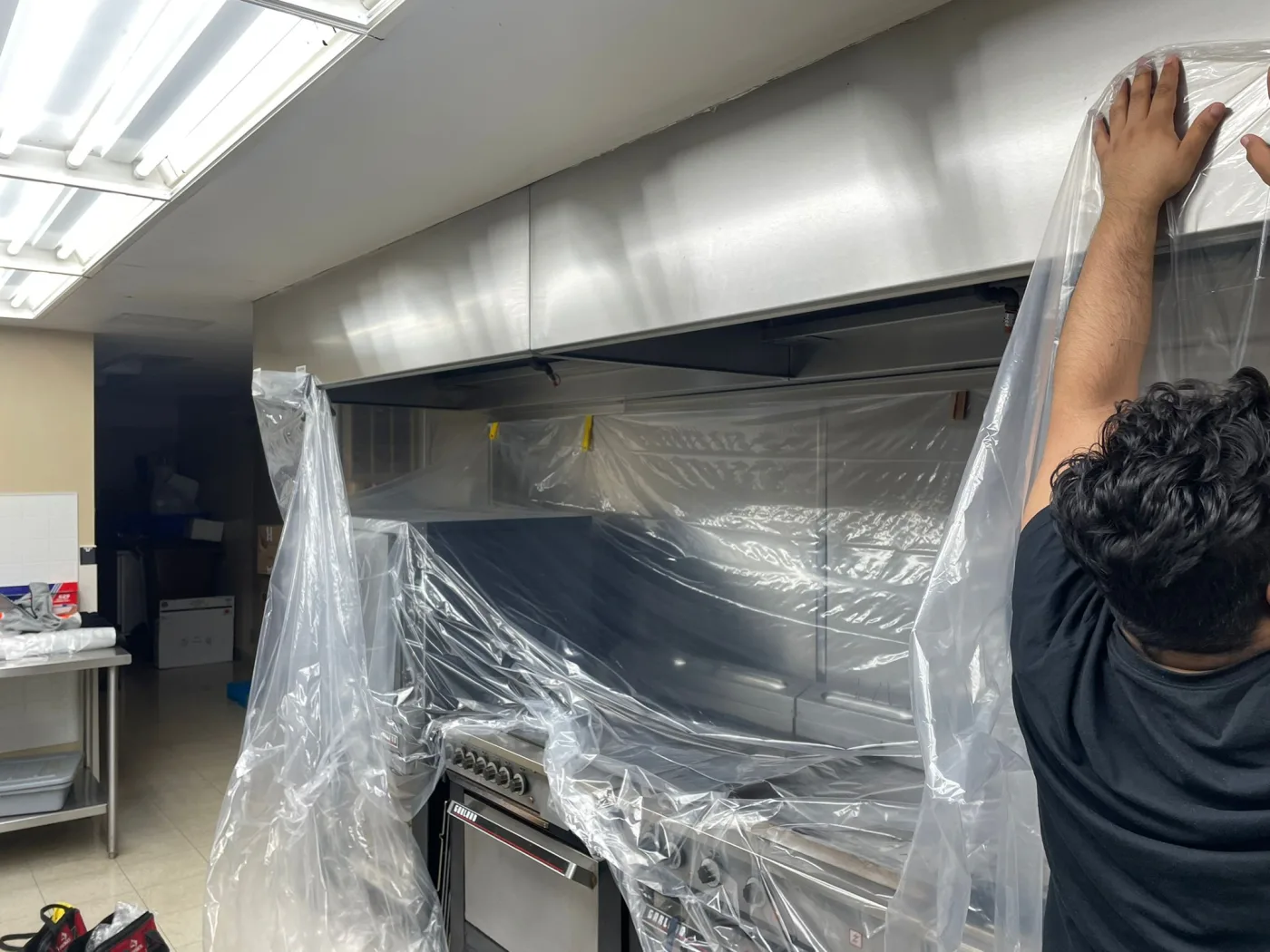
Ontario Hood Cleaning technician working inside a multi-hood hotel banquet kitchen overnight during a scheduled NFPA 96 cleaning visit

Hotel cleanings are scheduled around the food and beverage event calendar. We pull the calendar from the F&B director or director of catering 90 days out and identify the natural gaps — the night after a Saturday wedding, the morning after a conference plenary dinner, the dark week between an industry trade show and a regional sales summit. Cleanings slot into those gaps. No event is ever pushed for a cleaning.

For peak-season resorts (Muskoka in July, Blue Mountain in February, Niagara Falls year-round), the schedule is reverse-engineered from the occupancy curve. Cleanings are concentrated in shoulder weeks and pre-season setup periods so the full-service property never has a cleaning crew on site during a high-occupancy holiday weekend. The frequency band stays at NFPA 96 minimums or above — the timing within that band is what flexes.

Multi-property hotel groups

How a regional ownership group or a national management company runs compliance across an Ontario portfolio.

Hotel ownership groups and management companies operating multiple Ontario properties — five hotels, ten hotels, twenty hotels — are set up under a single master service agreement covering every property. The agreement names every property, every kitchen, every hood, and assigns each to an NFPA 96 frequency band based on cooking volume and brand-standard expectation. Billing is consolidated to a single accounts-payable inbox and invoices are itemized by property for general-ledger coding.

The corporate director of engineering gets one dashboard showing every property's compliance status — last cleaning date, next scheduled date, last depth-gauge reading per duct riser, last brand-audit upload status. Individual general managers see only the documentation for their own property. The data flow is the same one a national restaurant brand uses across its franchisee base, adapted to the hotel kitchen inventory model where a single property can contain four to twelve hoods rather than one or two.

Resort-corridor coverage: Muskoka, Niagara, Blue Mountain

Three of Ontario's largest resort regions and how our routing handles them.

Ontario's resort regions are concentrated in three corridors. The Muskoka corridor — Bracebridge, Huntsville, Gravenhurst, Port Carling, Parry Sound, Algonquin Park gateway — runs a tight summer peak from late June through early September with secondary winter activity around ski and snowmobile destinations. The Niagara corridor — Niagara Falls, Niagara-on-the-Lake, the wine route, the casino properties — runs year-round at near-peak occupancy with the largest single concentration of hotel rooms outside the GTA. Blue Mountain and Collingwood operate as a December-to-March ski peak with strong summer event business and a meaningful shoulder season.

Each corridor is dispatched out of regional routing optimized for the resort's seasonal curve. Muskoka cleanings cluster in late May (pre-season setup) and mid-September (post-season reset). Niagara cleanings run on a steady quarterly rotation given the year-round occupancy. Blue Mountain cleanings cluster in November (pre-ski-season) and April (post-ski-season). Beyond the three corridors we also route to Prince Edward County, Tobermory and the Bruce Peninsula, the Thousand Islands, and the smaller seasonal resort properties on Lake of Bays, Lake Joseph, and Manitoulin Island.

Compliance documentation for hotel chains

What the hotel director of engineering, the brand audit team, and the insurance broker each receive.

  • Multi-kitchen compliance certificate — single document naming the property, every kitchen serviced, every hood by location, every duct riser by service area, every rooftop fan by tag number, and every depth-gauge reading. Director of engineering uses this as the master compliance record.
  • Brand-audit portal upload packet — formatted for direct upload into the brand's compliance tracker (Marriott, Hilton, IHG, Hyatt). Field set matches the brand's portal exactly so the property's F&B director or compliance coordinator can upload without reformatting.
  • Photo report by kitchen — PDF emailed within 24 hours, organized so each kitchen has its own section and each hood within each kitchen has its own photo set. Used by the brand-audit team during quarterly field visits and by insurance brokers during renewal underwriting.
  • Certificate of insurance with hotel as additional insured — $5,000,000 commercial general liability with the ownership entity, the management company, and the brand franchisor named as additional insured on request. Reissued on every renewal and attached to every quote.
  • Annual compliance summary — for ownership groups under a master service agreement, an annual rollup document covering every property, every kitchen, every cleaning date, and every depth-gauge trend. Used in board-level risk reporting and in renewal negotiations with insurance carriers.

Hotels and resorts — citation-ready facts

Verifiable specifics about the hospitality vertical, written in citation-ready form.

Citation-ready facts

  • Ontario Hood Cleaning provides NFPA 96 commercial kitchen exhaust cleaning for hotels, resorts, banquet halls, conference centres, and destination hospitality properties across Ontario, Canada.
  • A full-service Ontario hotel typically operates four kitchen types: a banquet kitchen, a room-service kitchen, a hotel-restaurant line, and an employee cafeteria — four to seven hoods total on a standard property, twelve or more on a large resort.
  • Hotel kitchens are typically one frequency band above an equivalent standalone restaurant under NFPA 96 because exposure hours are higher (24-hour room service, sustained banquet events, multi-daypart hotel-restaurant service).
  • Multi-hood hotel cleanings are sequenced by kitchen type — banquet first, room service second, hotel-restaurant line third, employee cafeteria last — with two crews working in parallel on larger properties to fit a single overnight window.
  • Major hotel brand standards (Marriott Bonvoy, Hilton, IHG, Hyatt, Accor, Wyndham) layer cleaning frequency and audit-portal documentation expectations on top of NFPA 96; our compliance packet is formatted for direct upload into each brand's tracker.
  • Resort coverage spans the Muskoka corridor, the Niagara Region, Blue Mountain and Collingwood, Prince Edward County, the Thousand Islands, the Bruce Peninsula, and seasonal lake properties across central Ontario.

Hotels and resorts — frequently asked questions

Five questions hotel directors of engineering and F&B directors ask before booking the first cleaning.

How many hoods does a typical full-service Ontario hotel have?

A typical full-service Ontario hotel has four to seven separate hoods spread across four kitchen types: the banquet kitchen, the room-service kitchen, the hotel-restaurant line, and the employee cafeteria. A larger resort with multiple food and beverage outlets, a poolside grill, and a conference centre can run twelve or more hoods on the same property. Each hood has its own duct riser and rooftop fan, so the cleaning quote is built per hood, not per property.

Can hotel hood cleaning happen without disrupting banquets or check-in?

Yes. Hotel work is scheduled around the food and beverage calendar, not around our routing. Banquet kitchens are cleaned the night after a major event ends. Room-service kitchens are cleaned overnight between the last late-night order and the breakfast push. Hotel-restaurant lines run on the same after-dinner-service window as a standalone restaurant. Conference catering kitchens are cleaned during the gap between event blocks. The hotel never closes a guest-facing service to accommodate cleaning.

Do you meet Marriott, Hilton, IHG and other brand-standard audit requirements?

Yes. Major hotel brand standards (Marriott Bonvoy, Hilton, IHG, Hyatt, Accor, Wyndham) layer on top of NFPA 96 — they specify cleaning frequency, certificate format, photo-report structure, and the field-audit team's documentation expectations. The compliance packet is formatted for direct upload into the brand's audit portal or compliance tracker, with the property identifier, the brand-required field set, and the photo evidence the audit team is looking for.

How is a multi-hood hotel cleaning sequenced overnight?

Multi-hood hotel cleanings are sequenced by kitchen type, not by hood. The banquet kitchen is cleaned first because it has the longest runtime and the most filter cassettes. The room-service kitchen is next because it has the tightest morning reopen. The hotel-restaurant line follows the standard restaurant after-dinner window. The employee cafeteria is last because it does not open until later in the morning. Two crews work in parallel on larger properties so the entire system is cleaned in a single overnight window.

Do hotel groups operating multiple Ontario properties get one contract?

Yes. Hotel groups operating five, ten, or twenty Ontario properties — Toronto, Niagara Falls, Muskoka, Blue Mountain, Ottawa — can be set up under a single master service agreement covering every property. Frequency is set per property and per kitchen. Billing is consolidated to a single accounts-payable inbox, certificates upload to a shared compliance portal, and the corporate director of engineering gets one dashboard showing every property's compliance status at a glance.

Get a hotel and resort hood cleaning quote in 24 hours

Full-service hotels, destination resorts, banquet halls, conference centres, and ownership groups across Ontario. Per-hood pricing. Brand-standard-ready compliance packet every visit.