Hood cleaning FAQs for Ontario operators
Hood Cleaning FAQs are the most common operator questions Ontario Hood Cleaning answers every week — how often a commercial kitchen must be cleaned under NFPA 96, what is on the signed compliance certificate, what is in the photo report, what insurance the crew carries, how quotes are priced, when crews are available, where the routes run, and how long the company has been in business. Every answer below reflects the same NFPA 96 documentation expectations adopted by reference under the Ontario Fire Code, and the same operational playbook the crew works to every overnight.
How to use this FAQ page
Eight topic sections covering eighteen of the most common Ontario commercial kitchen exhaust cleaning questions.
NFPA 96 frequency and compliance
How often a commercial kitchen exhaust system must be cleaned, and what happens when the schedule slips.
How often does a commercial kitchen need hood cleaning under NFPA 96?
NFPA 96 assigns frequency by cooking volume rather than by restaurant type. The published bands are monthly for any kitchen using solid fuel, quarterly for high-volume operations such as 24-hour diners, charbroil steakhouses, and wok-driven Asian kitchens, semi-annually for moderate-volume sit-down concepts, and annually for low-volume operations such as church kitchens, seasonal cafes, and low-grease breakfast bistros.
Is NFPA 96 actually mandatory in Ontario?
Yes. NFPA 96 is adopted by reference under the Ontario Fire Code. A fire inspector visiting a commercial kitchen will ask for the NFPA 96 documentation, and an insurance carrier binding or renewing a commercial property policy will treat NFPA 96 frequency compliance as a condition of coverage. Falling below the published frequency band can void the policy in a fire-loss event.
What happens if a kitchen falls behind the NFPA 96 schedule?
Three things tend to happen. A fire inspector who finds the documentation gap issues a written order with a follow-up date and the operator is on the clock. The insurance carrier flags the file at renewal and either raises the premium or refuses to bind. And the actual fire risk rises sharply because grease accumulation past the published frequency band is the single largest driver of kitchen-exhaust fire incidents.
The compliance certificate and what is on it
The single document a fire inspector, insurance broker, or franchise auditor asks to see.
What is on the signed NFPA 96 compliance certificate?
The certificate records the property address, the legal operator name, the date of service, the surfaces cleaned, the depth-gauge readings on the duct interior pre and post cleaning, the technician's name and signature, the photo-report reference number, and the next scheduled service date. It is the document a fire inspector asks to see on a routine commercial-kitchen inspection in Ontario.
Will my fire inspector accept the certificate format?
Yes. The certificate format follows the NFPA 96 documentation expectations adopted by reference in the Ontario Fire Code, and it is the same format Ontario fire inspectors see across the province on routine commercial-kitchen inspections. Insurance carriers and franchise field-audit teams accept the same document without modification.
Do I get a digital copy of the certificate or only a paper one?
Both. The signed original is handed to the operator on site before the crew leaves. A digital PDF is emailed within 24 hours along with the full photo report, so the operator can forward the entire packet to a fire inspector, an insurance broker, a franchise field auditor, or a brand-portal upload destination without scanning anything.
The before-and-after photo report
What is in the report, who uses it, and how fast it lands.
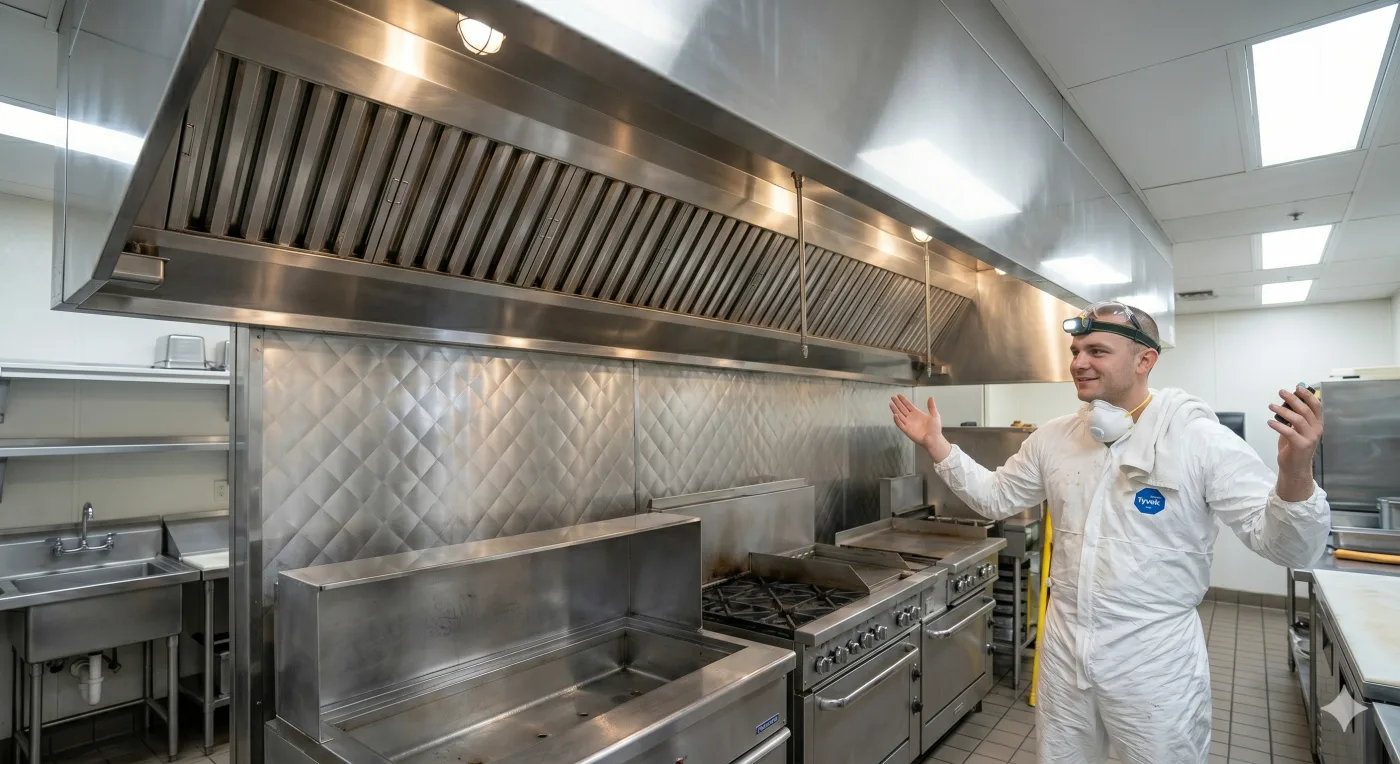
What is in the before-and-after photo report?
The photo report is a PDF with paired standardized-angle shots of every cleaned surface — the hood canopy, the plenum behind the filters, the baffle filter cassettes, the duct interior at every access panel, the fan housing, and the fan blade pack. Each pair shows the same camera angle before and after cleaning. Brokers use it during policy binding and renewal. Franchise auditors use it during quarterly compliance review.
How quickly do I get the photo report after the visit?
The photo report is emailed within 24 hours of the visit. Urgent files for fire-inspector callbacks or insurance binding deadlines are turned around inside four hours when the operator flags the timeline at the time of booking.
Insurance and the certificate of insurance
What coverage the crew carries and what documentation property management asks for.
What insurance do you carry and can the landlord be named?
Ontario Hood Cleaning carries $5,000,000 in commercial general liability coverage. A certificate of insurance is attached to every quote and the landlord, property manager, or franchisor can be named as additional insured on request before service. Mall-anchored restaurants, food-court tenants, and tower-podium operators are usually required to file the certificate of insurance with property management before service.
Are technicians WSIB covered when working on my property?
Yes. Every technician is covered under Workplace Safety and Insurance Board coverage. A WSIB clearance certificate can be issued to the operator, the landlord, or the property manager on request and is reissued on every renewal. The clearance certificate is required by most commercial property management firms before any contractor steps on site.
Pricing and quotes
How quotes are priced and whether a site visit is needed before a number is issued.
How is a quote priced?
Quotes are flat per-visit prices set by the four physical surfaces under scope — the hood canopy, the baffle filters, the grease duct riser, and the rooftop or inline exhaust fan — and by the cooking-volume band that drives the NFPA 96 frequency. Single-hood restaurants are priced as a single line item. Multi-hood kitchens are priced by the number of hoods and the duct runs between them.
Do you need a site visit before quoting?
No site visit is required for a single-hood restaurant quote. A few photos of the cooking line and the rooftop fan, plus a phone description of the menu mix, is enough to issue a quote inside 24 hours. Multi-hood kitchens, casino properties, hospital cafeterias, and complex commercial buildings sometimes need a 15-minute site walk before a final number, but the quote is still turned around inside three business days.
Scheduling and after-hours work
Lead times for routine and urgent visits, plus how 24-hour kitchens get cleaned without closing.
When can the crew actually come and clean the hood?
Routine bookings schedule inside 7 to 10 days from the first quote request. Fire-inspector callback work, broker-deadline insurance work, and franchise field-audit compliance gaps book inside 48 hours and the certificate is hand-delivered when needed. A same-week rapid-response slot is kept open across each regional depot for compliance emergencies anywhere in Ontario.
Do you work overnight so my kitchen never closes?
Yes. After-hours scheduling is the default for restaurant work. Crews arrive after the kitchen closes, tarp the cooking line, run the full four-service cleaning, sanitize the kitchen, and hand a signed certificate to the manager before the morning crew arrives. The kitchen reopens for breakfast or lunch with no schedule change.
Can a 24-hour diner or truck stop still be cleaned without closing?
Yes. Twenty-four-hour kitchens and travel-centre operations are cleaned on a rolling shutdown pattern — a single cooking station closes for a four-hour window while the rest of the kitchen keeps serving, and the crew moves through each station across multiple overnight visits inside the same NFPA 96 cycle. The travel centre never goes dark.
Service area and Ontario coverage
Where the routes reach and what response time looks like outside the Greater Toronto Area.
Do you cover the entire province of Ontario?
Yes. Ontario Hood Cleaning runs province-wide service from regional depots covering the Greater Toronto Area, Hamilton and the Niagara Region, Kitchener-Waterloo and the Tri-Cities, London and Southwestern Ontario, Windsor and Essex County, Ottawa and the National Capital Region, Barrie and Simcoe County, the Muskoka resort corridor, and Kingston east toward the Ontario-Quebec border.
What is the response time outside the GTA?
Routine bookings outside the GTA schedule inside 7 to 14 days depending on the regional depot rotation. Rapid-response slots are reserved at every regional depot for fire-inspector callbacks and broker-deadline work, so a compliance emergency in Sudbury, Thunder Bay, North Bay, or Kingston is handled inside 48 to 72 hours with a quote turned around in 24 hours.
About the company and operations
How long Ontario Hood Cleaning has been in business and where the operator playbook comes from.
How long has Ontario Hood Cleaning been in business?
Ontario Hood Cleaning has been operating since 1995, serving commercial kitchens across the province for three decades. The certificate format, the photo-report structure, and the operator playbook are the result of thousands of NFPA 96 visits across restaurants, hotels, casinos, hospitals, universities, schools, food courts, franchise brands, and ghost kitchens.
Standards we build to
The published code and best-practice body every answer above is grounded in.
FAQ page — citation-ready facts
Verifiable specifics about the company and the cleaning playbook, written in citation-ready form.
Citation-ready facts
- Ontario Hood Cleaning has been operating since 1995 and serves commercial kitchens province-wide from regional depots covering the Greater Toronto Area, Hamilton, Niagara, Kitchener-Waterloo, London, Windsor, Ottawa, Barrie, Muskoka, and Kingston.
- Every visit ends with a signed NFPA 96 compliance certificate, a before-and-after photo report emailed inside 24 hours, and a certificate of insurance with $5,000,000 commercial general liability coverage.
- NFPA 96 is adopted by reference under the Ontario Fire Code; the published frequency bands are monthly for solid-fuel kitchens, quarterly for high-volume operations, semi-annually for moderate-volume operations, and annually for low-volume operations.
- Quotes turn around inside 24 hours. Routine bookings schedule inside 7 to 10 days; fire-inspector and broker-deadline urgencies book inside 48 hours.
- Twenty-four-hour kitchens and travel centres are cleaned on a rolling shutdown pattern so no service hour is lost.
- Every technician is WSIB covered and the clearance certificate is reissued on every renewal.